
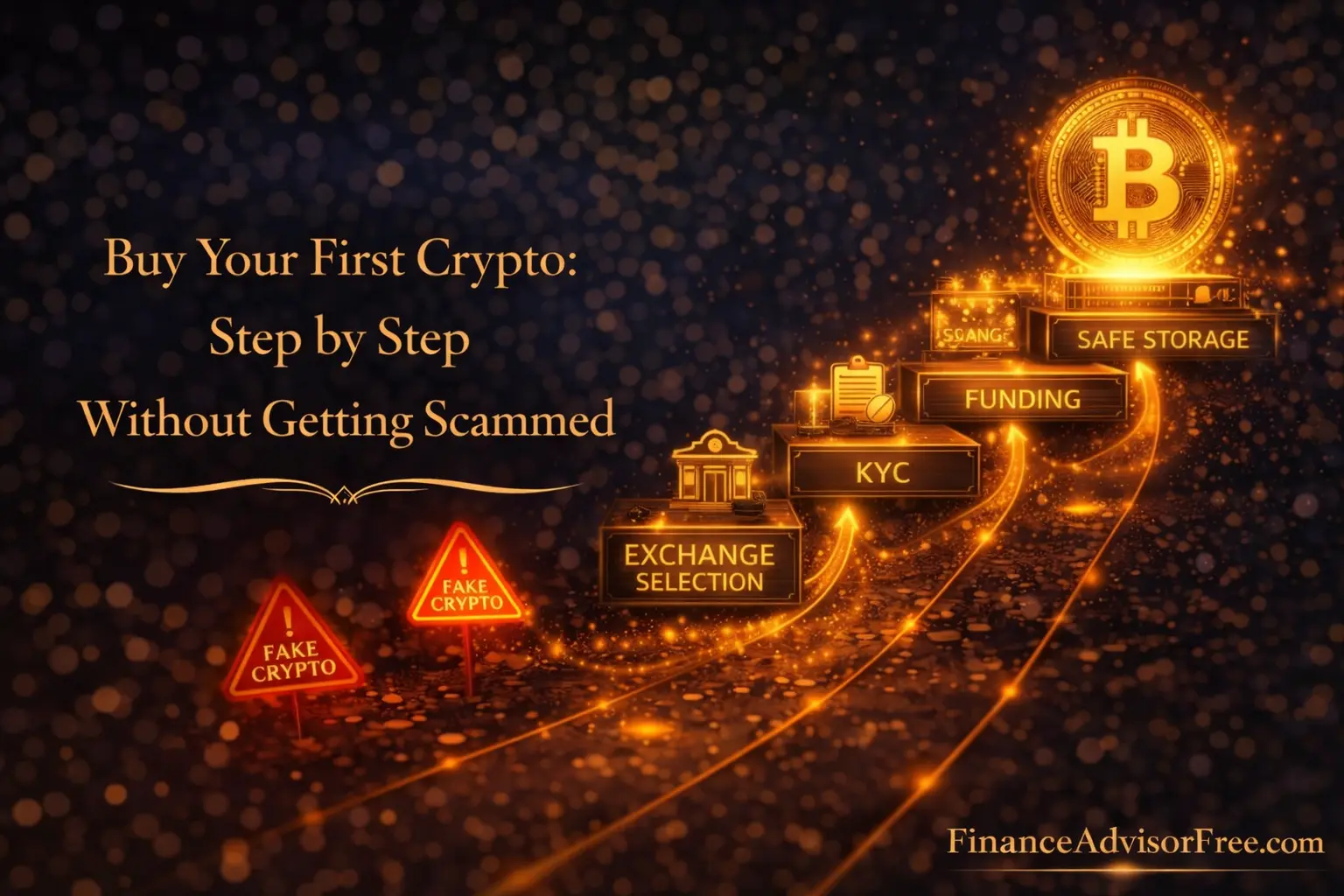
Knowing how to buy cryptocurrency safely is the single most important practical skill for any beginner entering the crypto space — because the process is straightforward when done correctly, and financially devastating when done wrong. This guide walks through every step from choosing an exchange to completing your first purchase, with specific warnings about the scams that target new buyers at each stage.
💡 Also in this cluster:
Cryptocurrency Explained for Complete Beginners — What It Is, How It Works and Whether You Need It
Crypto Wallets Explained — Hot Wallets, Cold Wallets and How to Actually Keep Your Coins Safe
Before You Buy: The Preparation That Most Guides Skip
The biggest mistakes in crypto happen before the first purchase, not during it. Rushing into buying because of fear of missing out — a feeling so common in crypto that it has its own acronym, FOMO — is responsible for more financial losses than almost any technical error. Before you spend a single dollar, you should have clear answers to three questions: Why are you buying? What are you buying? How much can you genuinely afford to lose entirely?
If your answers are “because the price is going up,” “I’m not sure yet,” and “more than I’m comfortable admitting,” please read our foundational guide first. If you have clear, considered answers and are ready to proceed, the actual process of buying cryptocurrency is straightforward — the complexity is in doing it safely.
Step 1: Choose a Regulated Cryptocurrency Exchange
A cryptocurrency exchange is a platform where you can buy, sell, and sometimes store cryptocurrency. Choosing the right one is the most consequential decision in this process. The exchange holds your funds during and after purchase — choosing an unregulated or fraudulent exchange can mean losing everything before you even own a single coin.
What Makes an Exchange Trustworthy?
Regulation is the most reliable signal of legitimacy. Look for exchanges that are registered with financial regulators in major jurisdictions: FinCEN and state money transmitter licences in the US, FCA registration in the UK, MiCA authorisation in the EU (which became fully enforceable in 2024), or equivalent oversight in your country. Regulated exchanges are required to implement Know Your Customer (KYC) and Anti-Money Laundering (AML) procedures — which means they will ask for your identity documents. This is not a red flag; it is a legal requirement and a sign the exchange operates within the law.
Other trust indicators include: proof of reserves (the exchange publicly proves it holds the assets it claims), long operating history, large trading volume, clear fee structures, responsive customer support, and whether the exchange has experienced any major security breaches and how it handled them. An exchange that covered losses from a hack out of its own reserves demonstrates far more trustworthiness than one that simply went offline.
| Exchange | Best For | Key Regulated Markets | Typical Buying Fee | Beginner-Friendly? |
|---|---|---|---|---|
| Coinbase | Complete beginners | US, EU, UK | 0.6% – 1.49% | Yes — excellent UX |
| Kraken | Security-conscious users | US, EU, UK | 0.26% – 1.5% | Yes |
| Binance | Wider coin selection | EU, parts of Asia (not US) | 0.1% – 0.5% | Moderate — complex interface |
| Gemini | Regulatory compliance focus | US, EU, UK, Canada | 0.5% – 1.49% | Yes |
| Bitstamp | European users, low fees | EU, US, UK | 0.3% – 0.5% | Yes |
Step 2: Create and Verify Your Account
Account creation on a regulated exchange involves three stages: basic registration (email and password), identity verification (KYC), and enabling security features. Do not skip or rush any of these.
Identity Verification (KYC)
KYC verification typically requires a government-issued photo ID (passport or driving licence), a selfie or short video for facial recognition, and sometimes proof of address (utility bill or bank statement). This process can take anywhere from a few minutes to a few days depending on the exchange and your country. In some cases, higher purchase limits require enhanced verification. Start the KYC process well before you want to make your first purchase — do not start it in a hurry when you think the market is moving in your favour.
Security Settings You Must Enable Immediately
Two-factor authentication (2FA) is not optional — it is essential. Enable it using an authenticator app (Google Authenticator, Authy, or similar) rather than SMS. SMS-based 2FA is vulnerable to SIM-swapping attacks, where a criminal convinces your mobile carrier to transfer your phone number to a SIM card they control. Use a strong, unique password that you have not used anywhere else, stored in a password manager. If the exchange offers a withdrawal whitelist feature — which restricts withdrawals to only pre-approved addresses — enable it. Configure email alerts for all account activity. These steps take ten minutes and can prevent the loss of everything in your account.
Step 3: Fund Your Account
Most exchanges offer several methods for depositing money: bank transfer, debit card, credit card, and sometimes PayPal or other payment services. Each has different speed and cost characteristics that you should understand before choosing.
Bank Transfer vs Card Purchase
Bank transfers (SEPA in Europe, ACH in the US, Faster Payments in the UK) are almost always the cheapest way to deposit funds — often free or very low fee. The drawback is speed: depending on your bank and the exchange, it can take 1–3 business days for funds to arrive. Debit and credit card purchases are instant but carry higher fees — often 1.5–3.5% on top of the exchange’s trading fee. Credit card purchases are also treated as cash advances by many banks, which means additional bank fees and interest charges even if you pay your balance in full. For most beginners, a bank transfer is the better option unless speed is genuinely critical.
Step 4: Place Your First Order
Once your account is funded, buying cryptocurrency is a straightforward process on most beginner-friendly exchanges. Navigate to the buy screen, select the cryptocurrency you want to purchase (Bitcoin or Ethereum are the recommended starting points for first-time buyers), enter the amount in your local currency, review the transaction including all fees, and confirm.
Understanding Order Types
Most beginners use a market order, which purchases the cryptocurrency immediately at the current market price. This is the simplest approach and perfectly appropriate for your first purchase. A limit order allows you to specify a price at which you want to buy — your order will only execute if the market reaches that price. Limit orders are more sophisticated and not necessary for a first purchase, but they can reduce costs on larger purchases by avoiding buying at a spike in price.
Understanding Fees in Full
The total cost of a crypto purchase includes the trading fee (the exchange’s cut, typically 0.1–1.5% of the transaction), the spread (the difference between the buy and sell price), and any deposit fee you paid. On some exchanges, the “simple” interface designed for beginners charges significantly higher fees than the “advanced” or “pro” interface. On Coinbase, for example, using Coinbase Advanced Trade rather than the simple buy interface can reduce trading fees substantially. Once you understand the process, it is worth exploring whether your exchange offers a lower-cost interface.
Step 5: Decide Where to Store Your Cryptocurrency
After buying, your cryptocurrency sits in your exchange account by default. This is convenient but carries risk — if the exchange is hacked, goes bankrupt (as FTX did in 2022, causing billions in losses for customers), or freezes withdrawals, you may lose access to your funds. The crypto community’s most repeated piece of advice is “not your keys, not your coins” — meaning that true ownership of cryptocurrency requires holding it in a wallet where you control the private keys.
For small amounts and active traders, keeping funds on a reputable regulated exchange is a reasonable pragmatic choice. For larger amounts or long-term holdings, moving your cryptocurrency to a personal wallet — ideally a hardware wallet — significantly reduces counterparty risk. Our complete guide to crypto wallets covers every option in detail, from free software wallets to hardware wallets, and exactly how to use each one safely.
The Scams That Target Cryptocurrency Buyers in 2026
The crypto space attracts sophisticated fraudsters because transactions are irreversible and relatively anonymous. Knowing the most common scam patterns is the best protection against them.
Fake Exchange and Wallet Websites
Fraudsters create websites that look identical to legitimate exchanges or wallets. They drive traffic through Google ads (yes, fake crypto exchanges have appeared at the top of Google search results), social media links, and phishing emails. Always type the exchange URL directly or use official bookmarks. Never click exchange links in emails. Check the padlock icon and verify the exact domain name before entering any credentials.
Investment “Opportunities” with Guaranteed Returns
Any platform promising guaranteed returns on cryptocurrency — whether 10% monthly, daily compounding, or any fixed return — is either a Ponzi scheme or running an unsustainable business model that will collapse. Legitimate crypto investments carry risk of loss; guaranteed returns do not exist in volatile markets. The FTX collapse, the Terra/Luna implosion, and dozens of smaller schemes all involved promises that turned out to be fraudulent.
Romance and Celebrity Scams
Romance scams involving crypto have cost victims billions globally. A fraudster builds an online relationship over weeks or months, then introduces a “can’t-miss” crypto investment opportunity. Celebrity impersonation scams use fake social media accounts or deepfake videos of well-known figures promoting crypto platforms. Rule of thumb: no legitimate investment is ever offered via a personal relationship formed online.
Pump and Dump Schemes
Coordinated groups buy a low-value cryptocurrency, promote it heavily on social media and messaging apps, then sell when the price has risen — leaving later buyers with a rapidly devaluing asset. If you see urgent “this coin is about to 100x” messaging in any online community, that is almost certainly a pump-and-dump operation. Stick to well-established cryptocurrencies for your first purchases.
Tax Considerations When Buying Cryptocurrency
In most countries, cryptocurrency is treated as a capital asset for tax purposes, which means buying it does not trigger a taxable event — but selling it, trading it for another cryptocurrency, or using it to purchase goods or services typically does. The specific rules vary by country, and tax treatment of crypto has been evolving rapidly. In the US, the IRS requires reporting of all crypto transactions. In the UK, HMRC treats crypto gains as capital gains. In the EU, MiCA implementation has brought more consistent reporting requirements. Keep detailed records of every purchase: the date, amount paid, amount of crypto received, and the exchange rate at the time. This information is essential when you eventually sell and need to calculate your gain or loss.
Frequently Asked Questions
What is the minimum amount I can buy?
Most regulated exchanges allow purchases of $10 or less in many cryptocurrencies, since Bitcoin and Ethereum are divisible into very small fractions. Coinbase, for example, allows purchases as small as $2 in some regions. However, extremely small purchases are generally not recommended as a serious investment strategy because trading fees represent a much higher percentage of small transactions. A starting amount of $50–$200 is more practical for actually learning how the market behaves without putting significant capital at risk. Think of your first purchase as tuition in the form of a small, considered bet on an asset you have genuinely researched.
How long does it take to buy cryptocurrency?
The account creation and verification process is typically the longest part — KYC verification can take from a few minutes to several business days depending on the exchange and the volume of applications they are processing. Once your account is verified and funded, the actual purchase of cryptocurrency takes seconds using a market order. If you are funding via bank transfer, add 1–3 business days for the funds to arrive. Card purchases are instant but more expensive. For your first purchase, begin the account opening and verification process at least a week before you intend to buy, so that delays in document verification do not cause you to miss a desired price level.
Should I buy Bitcoin or another cryptocurrency first?
For almost all beginners, Bitcoin (BTC) or Ethereum (ETH) are the appropriate first purchases. They are the most established, most liquid, most regulated, and most widely studied cryptocurrencies in existence. Their market capitalisation dwarfs that of most other coins, which provides some (though not complete) protection against the kind of catastrophic collapse that can affect smaller coins. Altcoins — particularly new or obscure ones — carry substantially higher risk of total loss, and the research required to evaluate them responsibly is beyond most beginners. Once you understand how Bitcoin and Ethereum work and have experienced a full market cycle, you will be in a much better position to evaluate whether any altcoin merits your attention.
What happens if the exchange goes out of business?
This is not a hypothetical risk — the collapse of FTX in late 2022 left millions of customers unable to access their funds, with many ultimately recovering only a portion of their balances through lengthy bankruptcy proceedings. If you hold crypto on a regulated exchange in a jurisdiction with strong consumer protection (such as the EU under MiCA or the US for regulated custodians), you have some legal protections, but these are not equivalent to bank deposit insurance. The most reliable protection is to withdraw your cryptocurrency to a personal wallet that you control. If the exchange collapses, cryptocurrency held in your own wallet is unaffected. This is why understanding crypto wallets — and moving at least your larger holdings to self-custody — is the next step after making your first purchase.
This article is for informational purposes only and does not constitute financial or investment advice. Cryptocurrency is a highly volatile and speculative asset class. Exchange names, fee structures and regulatory status mentioned are subject to change. Please consult a qualified financial advisor before making any investment decisions.