
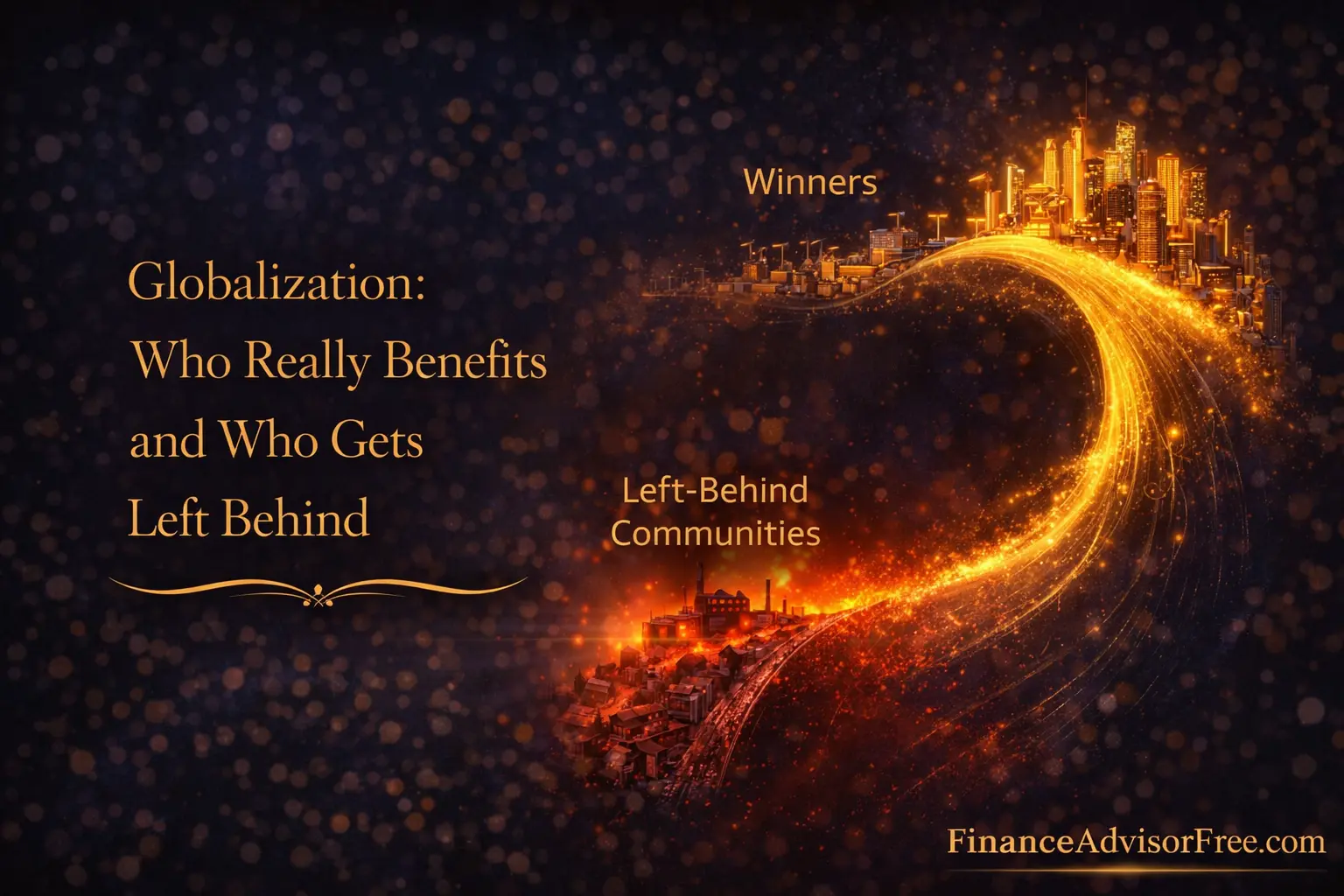
Globalization is simultaneously one of the most celebrated and most contested economic forces of the past century. Proponents point to the extraordinary reduction in global poverty, the explosion in consumer choice, and the productivity gains that have made goods cheaper and technology more accessible than at any previous point in history. Critics point to the hollowing out of manufacturing communities in developed countries, the suppression of wages for the workers who most directly compete with low-cost global labour, and the environmental degradation that has accompanied the rapid industrialisation of the developing world. Both arguments are supported by evidence — which is precisely what makes globalization one of the most important and genuinely complex topics in economics. This guide gives you the complete picture.
💡 Also in this cluster:
How the Global Economy Works — The Interconnected System That Determines Your Standard of Living
The World’s Largest Economies in 2026 — Rankings, Trends and What They Mean for Investors
What Globalization Actually Means
Globalization refers to the process by which national economies, societies, and cultures have become increasingly integrated and interdependent through the cross-border flow of goods, services, capital, people, and information. It is not a single policy decision or a discrete event — it is a gradual, multi-decade process accelerated by deliberate policy choices (trade liberalisation, capital account opening), technological advances (container shipping, the internet, cheap air travel), and institutional developments (the WTO, regional trade agreements, global financial integration).
The current wave of economic globalization is typically dated from the late 1970s through the present — characterised by the dismantling of trade barriers, the opening of capital accounts in developing countries, the integration of China and then India into the global trading system, and the digital revolution that made services tradable in ways previously impossible. Global trade as a share of world GDP rose from approximately 25% in 1970 to nearly 60% by 2008, a dramatic integration that transformed production, consumption, and economic geography worldwide.
Globalization is not limited to economics — it encompasses cultural exchange, migration, environmental interdependence, and the spread of information and ideas across borders. But its economic dimensions are the most directly measurable and the most consequential for financial outcomes, so this guide focuses primarily on economic globalization and its distributional consequences.
The Winners — Where Globalization Has Delivered Extraordinary Results
The Developing World Middle Class
The most unambiguous winner from economic globalization is the emerging middle class of developing countries — particularly in Asia. China’s integration into the global trading system from the 1980s through the 2010s is perhaps the most dramatic poverty reduction in human history: the share of China’s population living in extreme poverty fell from approximately 88% in 1981 to under 1% by 2020, lifting nearly 800 million people out of poverty in four decades. Similar, if less dramatic, progress occurred in Vietnam, Bangladesh, Cambodia, India, and other countries that integrated into global supply chains as manufacturing exporters.
The mechanism is straightforward: when developing countries gain access to global markets, they can specialise in labour-intensive manufacturing for export, creating employment at wages that far exceed what domestic-market-only production would support, while generating the foreign exchange needed to import capital goods and technology. Workers who move from subsistence agriculture to manufacturing jobs see dramatic improvements in income, consumption, and life expectancy — even when the wages that represent transformation in their lives look meagre by developed-world standards.
Consumers in Developed Countries
Consumers in wealthy countries have benefited enormously from globalization through dramatically lower prices for manufactured goods. The cost of electronics, clothing, appliances, furniture, toys, and thousands of other products has fallen in real terms over the past three decades — in some cases dramatically. A television that represented three weeks of average wages in 1990 represented less than half a day’s wages by 2020. The deflationary impact of global supply chains on goods prices was a persistent feature of the 2000s and 2010s, effectively raising real purchasing power even for households whose nominal wages stagnated.
Owners of Capital and Skilled Workers
The gains from globalization have not been distributed evenly within developed countries. The primary beneficiaries within rich nations have been owners of capital and highly skilled workers whose labour complements rather than competes with low-cost global labour. Shareholders of companies that shifted manufacturing offshore captured substantial gains in corporate profits as labour costs fell. Professionals in finance, law, consulting, technology, and other knowledge-intensive fields experienced less wage competition from globalisation and benefited from the growing global market for their high-value services.
People living in extreme poverty (under $2.15/day), 1990: ~1.9 billion (36% of world population)
People living in extreme poverty, 2026 estimate: ~680 million (8% of world population)
China’s poverty rate fall: 88% (1981) → under 1% (2020)
Vietnam’s poverty rate fall: 64% (1993) → under 6% (2022)
Bangladesh’s poverty rate fall: 44% (1991) → under 14% (2022)
Global extreme poverty would have been 3x higher without trade growth, per World Bank research
The Losers — Who Gets Left Behind
Manufacturing Workers in Developed Countries
The most thoroughly documented negative consequence of globalization in developed countries is the impact on manufacturing workers — particularly those with limited education in regions where manufacturing was concentrated. The “China shock” research by economists David Autor, David Dorn, and Gordon Hanson documented that US regions most exposed to Chinese import competition between 1990 and 2010 experienced significant and persistent increases in unemployment, disability claims, and social pathology — and that these communities did not experience the adjustment that trade theory predicted, with workers smoothly transitioning to other employment.
Approximately 2 million US manufacturing jobs were lost directly to Chinese import competition between 1999 and 2011, with multiplier effects adding further employment losses in services dependent on manufacturing workers’ incomes. These losses were geographically concentrated in the Midwest, Appalachia, and parts of the South — communities that had built their economic identity around steel, textiles, furniture, and other industries that could not compete with dramatically lower Chinese wage costs. The gains from cheap imports that accrued to all consumers were diffuse; the losses from job displacement were concentrated and devastating for specific communities.
Workers in Developing Countries in Informal Sectors
Within developing countries, the gains from globalization have also been unevenly distributed. Workers employed in export manufacturing — particularly in China, Vietnam, Bangladesh, and other countries that successfully integrated into global supply chains — gained significantly. Workers in informal sectors, subsistence agriculture, and small-scale domestic services were less directly affected by trade but also received fewer of the gains. The rapid urbanisation and wage growth that accompanied industrialisation created new middle classes but also new inequalities, urban-rural divides, and social stresses.
Environmentally Stressed Communities
The rapid industrialisation of the developing world, driven partly by globalization, came at significant environmental cost. China’s air and water quality deteriorated dramatically during its manufacturing boom, before environmental policy eventually began to address the most severe pollution. Export-oriented agriculture has driven deforestation in Brazil, Indonesia, and other developing countries, as the global demand for soya, palm oil, beef, and timber created economic incentives that overwhelmed environmental protections. “Pollution havens” — countries with weaker environmental regulations that attract manufacturing to escape compliance costs — represent a genuine dimension of globalization’s negative externalities.
The Elephant Curve — Visualising Globalization’s Distributional Impact
Economists Branko Milanovic and Christoph Lakner produced one of the most illuminating visualisations of globalization’s distributional consequences: the “elephant curve,” which shows the change in real incomes across the global income distribution between 1988 and 2008. The curve resembles an elephant: a large body of very high gains for the global middle (primarily China’s emerging middle class), a dip at the shoulder (relatively poor income gains for the working classes of developed countries), and a raised trunk representing very high gains for the global top 1%.
The pattern captures the essential distributional story of globalization’s peak period: the biggest gains went to the emerging middle classes of developing Asia and to the wealthy in developed countries. The groups that gained least — or experienced genuine real income stagnation — were middle and lower-income workers in developed countries. This distributional profile directly explains the political backlash against globalization that became dominant in developed-country politics after 2016.
The Backlash — Why Globalization Became Politically Toxic
The political backlash against globalization that crystallised in 2016 with Brexit and the Trump election was not irrational — it reflected genuine economic grievances of communities that bore concentrated costs while diffuse benefits accrued to others. The standard economic argument for free trade — that the aggregate gains exceed the aggregate losses, and the winners can in theory compensate the losers — proved insufficient in practice when the compensation rarely materialised and the affected communities had no political mechanism to claim their share of the gains.
Trade adjustment assistance programs — designed to help displaced workers transition to new employment — were chronically underfunded, offered temporary benefits that rarely extended to full economic recovery, and were poorly designed for the community-level devastation that concentrated import competition caused. The political system proved unable to tax the distributed gains from trade and redistribute them to the concentrated losers — and the resulting resentment produced the most significant challenge to the post-WWII free trade consensus since its establishment.
The policy responses — tariffs, supply chain "reshoring," industrial policy subsidies — represent a genuine shift in the post-WWII consensus that is likely to persist regardless of which political party holds power. Understanding this political economy is essential for investors, because trade policy uncertainty has become a permanent feature of the investment landscape in ways it was not before 2016.
Deglobalization — Is the World Actually Fragmenting?
Talk of "deglobalization" — a reversal of the decades-long trend toward greater economic integration — has intensified since 2016 and accelerated after COVID-19 supply chain disruptions and the Russia-Ukraine war demonstrated the risks of deep interdependence with geopolitical adversaries. But the evidence for actual deglobalization is more nuanced than the political rhetoric suggests.
Global trade as a share of world GDP has not fallen dramatically — it remains far above 1990s levels. What has changed is the composition and geography of trade: a modest shift toward regional supply chains, a deliberate reduction in dependence on China for strategic goods (semiconductors, pharmaceuticals, critical minerals), and new trade flows as companies diversify their sourcing. The US-China trade relationship has actually remained large despite the trade war tariffs, as intermediary countries like Vietnam, Mexico, and India have emerged as processing points that smooth the trade flow.
Financial globalisation — the integration of capital markets — remains very deep, with correlations between national stock markets near historical highs. Digital trade in services continues to grow rapidly. The more accurate description of current trends is "selective deglobalization" — reducing strategic dependencies on potential adversaries while maintaining and deepening commercial ties in less sensitive areas. This selective fragmentation creates investment risks in specific sectors (particularly technology supply chains involving China) and opportunities in others (near-shoring beneficiaries like Mexico and India).
| Aspect | Direction | Investment Implication |
|---|---|---|
| Semiconductor supply chains | Reshoring / friend-shoring away from China | US, Taiwan, Korean chip makers benefit; TSMC dominance challenged |
| Pharmaceutical manufacturing | Some reshoring; India consolidating position | Indian pharma exporters; domestic API manufacturers |
| Consumer goods supply chains | Diversifying to Vietnam, Bangladesh, Mexico | Vietnam and Mexico manufacturing investment rising |
| Financial market integration | Deepening — correlations remain high | International diversification still reduces risk |
| Digital services trade | Strongly growing despite political friction | US technology platform companies continue global revenue growth |
| Energy trade | Restructuring post-Russia sanctions | LNG exporters; Middle East energy investment; renewables |
Frequently Asked Questions
Has globalization been good or bad overall?
The honest answer is that globalization has been genuinely good for global poverty reduction and consumer welfare in aggregate, while being genuinely bad for specific groups — particularly manufacturing workers in developed countries who bore concentrated costs without adequate compensation. The aggregate gains clearly exceed the aggregate losses by most economic measures: global poverty has fallen dramatically, living standards have risen, and goods prices have fallen in real terms. But economics is not a morality play where aggregate gains justify concentrated losses without redistribution, and the failure to adequately compensate the losers has produced legitimate political grievances. A more accurate answer than "good" or "bad" is: enormously beneficial in aggregate, with a distributional failure in wealthy countries that the political system is now correcting through more interventionist trade and industrial policy.
What does deglobalization mean for my investment portfolio?
Selective deglobalization creates several investment considerations. Companies with deeply China-integrated supply chains or significant China market revenue face ongoing policy uncertainty and potential disruption risk. Beneficiaries of supply chain diversification — manufacturers in Vietnam, India, and Mexico; logistics infrastructure providers; domestic semiconductor manufacturers — represent investment opportunities from this structural shift. Higher trade barriers and more regionalised production generally mean higher goods prices and lower productivity gains than the globalisation era produced, which is mildly inflationary. Portfolios with broad international diversification across both developed and emerging markets are better positioned to capture the gains from wherever economic growth is strongest, regardless of which regions benefit most from the new trade patterns.
Is globalisation responsible for growing inequality within wealthy countries?
Globalisation is a significant contributor to within-country inequality in wealthy nations but not the only one, and arguably not the primary one. Technology — particularly automation and the skill premium for high-education workers — has also substantially widened wage distributions independent of trade effects. Winner-take-all market dynamics, declining union density, monopsony power in labour markets, and tax policy changes that have favoured capital over labour all contributed alongside trade. The research consensus suggests that technology and automation have had a larger effect on wage inequality in developed countries than trade competition specifically, though the two are difficult to separate since global competition itself accelerates automation adoption. Immigration, housing supply restrictions, and other factors further complicate the distributional picture.
Can developing countries benefit from trade without the costs wealthy countries experienced?
The historical evidence suggests that developing countries that integrate into global trade with strong domestic institutions — labour protections, environmental regulations, financial supervision, and investment in education and infrastructure — capture more of the gains while suffering fewer of the social costs than those that integrate rapidly without these institutional foundations. South Korea, Taiwan, and Singapore achieved export-led industrialisation with relatively strong labour standards and significant investment in human capital. Countries that integrated more chaotically, with weaker institutions and greater exposure to capital flow volatility, suffered more severe crises and slower transformation. The lesson is that trade liberalisation works best as part of a broader development strategy, not as a substitute for institutional development.
This article is for informational purposes only and does not constitute financial or economic advice. Economic research cited reflects current scholarly consensus as of 2026. Please consult a qualified financial advisor for personalised investment guidance.