
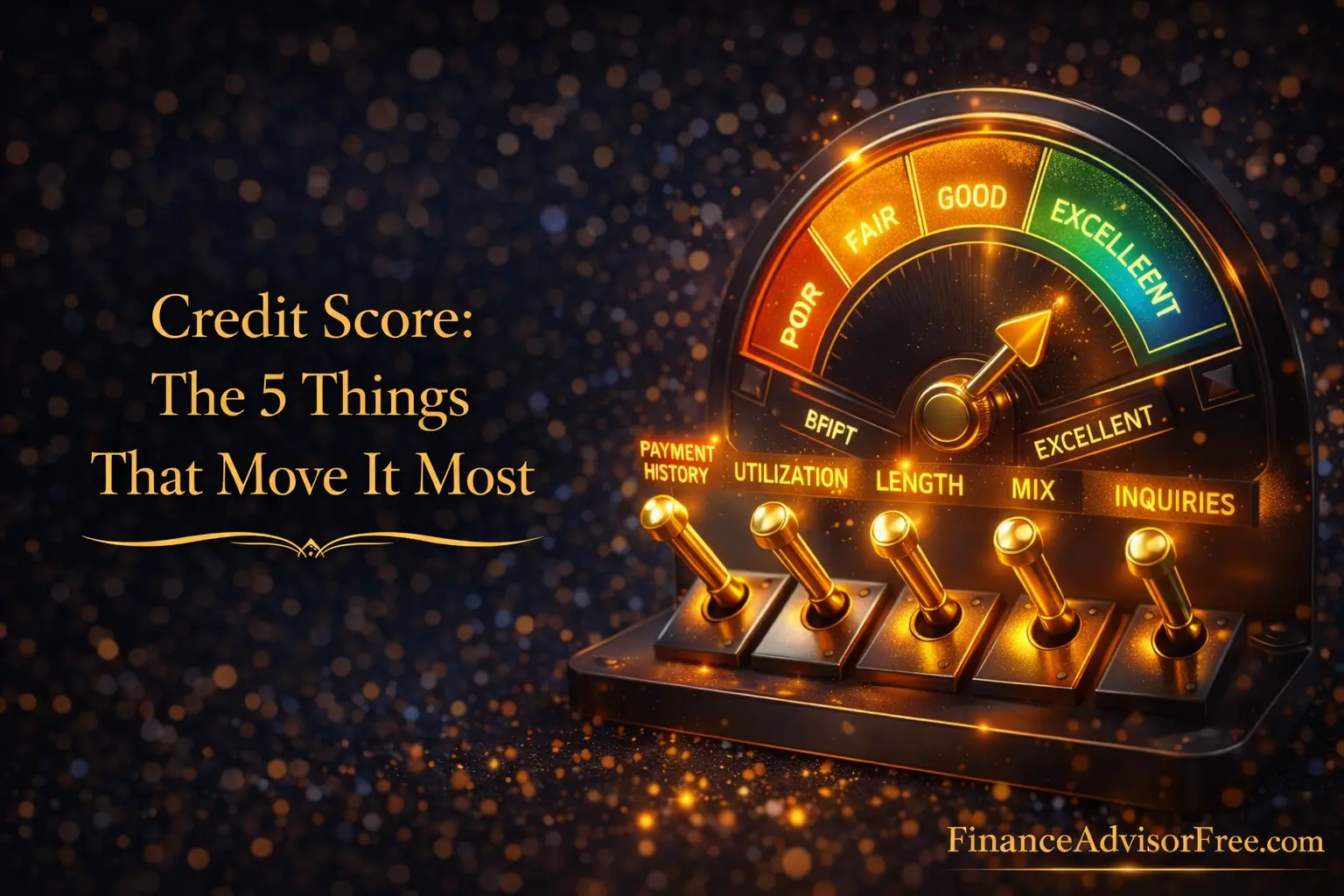
Understanding how your credit score is calculated gives you genuine control over a number that affects your mortgage rate, car loan cost, apartment approval, and in some states even your insurance premiums. Most people know their score matters but have only a vague sense of what actually moves it — which leads to well-intentioned actions that backfire and real opportunities for improvement that go untaken. This complete guide breaks down the FICO scoring model used by the vast majority of US lenders, explains each of the five factors in plain language, shows you the actions that move the score fastest, and debunks the most persistent myths that cause people to mismanage their credit profiles.
💡 Also in this cluster:
How to Improve Your Credit Score by 100 Points — Realistic Steps and a Timeline
Credit Score vs Credit Report — The Difference Most People Don’t Understand
What a Credit Score Actually Is
A credit score is a three-digit number — typically ranging from 300 to 850 — that summarises the information in your credit report into a single predictive figure representing your likelihood of repaying debt as agreed. Lenders use it as a fast, standardised screening tool to assess risk and set terms. Higher scores mean lower perceived risk, which translates to lower interest rates, higher credit limits, and easier approvals. Lower scores signal higher risk and result in higher rates, reduced limits, or outright denials.
The dominant scoring model in the US is the FICO Score, developed by Fair Isaac Corporation and used by approximately 90% of top lenders. FICO scores are calculated separately at each of the three major credit bureaus — Equifax, Experian, and TransUnion — using the information each bureau holds, which may vary slightly. This is why your score may differ by a few points depending on which bureau a lender checks. VantageScore is a competing model developed jointly by the three bureaus and increasingly used for consumer credit monitoring, though most lending decisions still rely primarily on FICO.
800–850 — Exceptional: Best available rates; nearly all credit applications approved
740–799 — Very Good: Better-than-average rates; strong approval odds
670–739 — Good: Near-prime rates; most mainstream credit available
580–669 — Fair: Subprime rates; some credit available with higher costs
300–579 — Poor: Very limited credit access; secured cards or credit-builder loans needed
Average US FICO Score in 2026: ~718 (falls in “Good” range)
The 5 Factors — How Each Is Weighted in the FICO Model
The FICO model weights five categories of credit behavior, each contributing a defined percentage to your overall score. Understanding these weights helps you prioritise which actions will have the greatest impact on your score in the shortest time.
Factor 1 — Payment History (35%)
Payment history is the single most important factor in your credit score, accounting for 35% of the total. It answers one question: do you pay your bills on time? Every account on your credit report has a payment history that shows whether each month’s payment was made on time, was late by 30 days, 60 days, 90 days, or more, or was sent to collections. A single missed payment — particularly on a large account — can drop your score by 50 to 100 points, with the damage being more severe the higher your starting score.
The good news: payment history is entirely within your control, and its negative impact fades over time. A late payment from three years ago hurts your score less than a late payment from six months ago. Negative payment information generally stays on your credit report for seven years, but its scoring impact diminishes each year as the negative event recedes into history and is offset by a growing track record of on-time payments.
The single most effective credit action available to almost anyone: set up autopay for every credit account for at least the minimum payment. This eliminates the possibility of a missed payment due to forgetfulness, travel, or illness. Pay more than the minimum separately if you choose, but autopay for the minimum ensures your payment history stays perfect regardless of what else is happening in your life.
Factor 2 — Amounts Owed / Credit Utilisation (30%)
Credit utilisation — the percentage of your available revolving credit that you are currently using — accounts for 30% of your score and is the fastest-moving factor in the model. It is calculated both per card and across all cards combined. A person with a $10,000 total credit limit carrying a $3,000 total balance has a 30% utilisation rate.
The conventional guidance is to keep utilisation below 30%, but scoring data consistently shows that borrowers with exceptional scores (800+) typically maintain utilisation below 10%. The relationship between utilisation and score is not linear — dropping from 80% to 50% produces a meaningful improvement, dropping from 50% to 30% produces a further improvement, and dropping from 30% to under 10% produces the most significant gains for most profiles.
Critically, utilisation is measured at the moment your lender reports to the credit bureaus — typically the last day of your billing cycle, which is often before your statement is even generated. Paying your balance in full each month does not guarantee low reported utilisation if your balance is high on the reporting date. To achieve low reported utilisation, either pay balances mid-cycle before the reporting date, or request credit limit increases to increase the denominator of the utilisation ratio.
Factor 3 — Length of Credit History (15%)
Length of credit history accounts for 15% of your score and includes the age of your oldest account, the age of your newest account, and the average age of all accounts. Older credit profiles score better because they provide more data about long-term payment behavior. This factor is largely a function of time — the most important thing you can do is avoid actions that shorten your credit history unnecessarily.
The most common mistake that shortens credit history: closing old credit card accounts after paying them off. A 10-year-old card you never use still contributes positively to your average account age. Closing it removes that history from your average age calculation (after 10 years when it ages off your report completely) and potentially reduces your available credit, increasing your utilisation ratio simultaneously. Keep old accounts open and occasionally use them for a small recurring charge to prevent the issuer from closing them for inactivity.
Factor 4 — Credit Mix (10%)
Credit mix accounts for 10% of your score and rewards borrowers who demonstrate responsible management of multiple types of credit: revolving accounts (credit cards, lines of credit), installment accounts (mortgages, car loans, student loans, personal loans), and open accounts (charge cards, some utility accounts). The rationale is that successfully managing different types of credit indicates broader financial capability.
You should not take on debt you do not need simply to improve your credit mix — the cost of unnecessary debt far exceeds any scoring benefit from diversification. However, if you currently have only revolving credit (credit cards) and have a legitimate need for a car or personal loan, knowing that the installment account will improve your mix adds a marginal additional benefit to that decision. Similarly, if you have only installment debt and no revolving credit, a single low-fee credit card maintained at low utilisation will meaningfully improve your score over time.
Factor 5 — New Credit / Hard Inquiries (10%)
New credit accounts for 10% of your score and includes two related elements: the number of recent hard inquiries on your report and the number of recently opened new accounts. A hard inquiry occurs when a lender pulls your credit report in response to a credit application — a new credit card, mortgage, car loan, or personal loan application. Hard inquiries typically reduce your score by 5 to 10 points each and remain on your credit report for two years, though their impact on your score typically fades after 12 months.
Multiple inquiries for the same type of loan — mortgage, car loan, student loan — within a short window (14 to 45 days depending on the FICO version) are treated as a single inquiry by the scoring model, recognising that rate shopping is a financially responsible behavior. Apply for all mortgage quotes within a 30-day window to avoid penalty. Credit card applications, by contrast, are each treated as separate inquiries — applying for five new credit cards in six months is a genuine negative signal that the model correctly identifies as potential financial stress.
| Factor | Weight | Fastest Way to Improve | Time to See Impact |
|---|---|---|---|
| Payment History | 35% | Set up autopay; never miss a payment | Immediate prevention; 1–2 years to repair damage |
| Credit Utilisation | 30% | Pay balances below 10% before reporting date | Next billing cycle (30 days) |
| Length of History | 15% | Keep oldest accounts open and active | Years — this factor grows slowly |
| Credit Mix | 10% | Add an installment loan if you only have revolving credit | 3–6 months after account opens |
| New Credit / Inquiries | 10% | Limit applications; rate-shop within 30 days | Impact fades after 12 months |
Common Credit Score Myths Debunked
Several persistent myths cause people to make decisions that actively harm their credit scores while believing they are helping. The most common and costly ones deserve direct correction.
The myth that checking your own credit score hurts it is false. Checking your own score through any monitoring service, bank, or credit bureau website is a soft inquiry that has zero impact on your score. Only hard inquiries — those initiated by lenders in response to credit applications — affect your score. Check your score as frequently as you like with no scoring consequences.
The myth that carrying a small balance on a credit card helps your score is false and expensive. You do not need to carry a balance to build credit history. Paying your balance in full every month while keeping utilisation low produces better scoring outcomes than carrying any balance — and saves significant interest. The myth persists because credit card companies benefit from people carrying balances and have an interest in perpetuating it.
The myth that closing paid-off credit cards improves your score is false. As described in the length of history section, closing accounts reduces your average account age and available credit, typically lowering your score rather than raising it. The exception is a card with a high annual fee that provides no commensurate benefit — in that specific case, the fee savings may justify the modest score impact of closure.
How to Monitor Your Credit Score for Free in 2026
Several free options for monitoring your credit score and report are available in 2026. AnnualCreditReport.com — the only federally mandated free credit report source — provides free access to your full credit report from all three bureaus weekly. Credit Karma and Credit Sesame provide free VantageScore monitoring with credit report summaries. Most major bank and credit card issuers — Chase, Discover, Capital One, Wells Fargo, Bank of America — provide free FICO score access through their online banking portals for cardholders, updated monthly. Experian offers a free FICO Score 8 through its website with a free account. Together, these resources give you complete, free visibility into your credit profile without purchasing any monitoring service.
Frequently Asked Questions
How quickly can a credit score change?
Credit scores update each time your lenders report new information to the bureaus, which typically happens once per month at the close of your billing cycle. The fastest-moving factor — credit utilisation — can produce a score change within 30 days of paying down a balance, since the lower balance is reflected at the next reporting date. Payment history changes more slowly: a new on-time payment improves your record incrementally each month, while a missed payment drops the score sharply and takes years of clean history to fully recover from. A significant credit score improvement — moving from 650 to 750, for example — typically requires six to twelve months of consistent positive behavior, though some improvement is visible within the first one to two billing cycles of implementing the right actions.
Does my income affect my credit score?
No. Income is not a factor in the FICO credit scoring model or any of the three bureau scoring models. A person earning $30,000 per year with a perfect payment history and low utilisation can have a higher credit score than a person earning $200,000 who misses payments and carries high balances. Income information is not reported to credit bureaus by default. Lenders may consider income separately when making credit decisions — as part of debt-to-income ratio calculations, for example — but income has no direct relationship to your credit score number.
How long do negative items stay on my credit report?
Most negative information — late payments, collections, charge-offs — remains on your credit report for seven years from the date of the first missed payment. Chapter 13 bankruptcy stays for seven years; Chapter 7 bankruptcy stays for 10 years. Hard inquiries remain for two years but only affect your score for approximately 12 months. The key insight: while the negative item stays on your report for the full period, its impact on your score diminishes over time, particularly as new positive payment history accumulates. A late payment from five years ago surrounded by four years of perfect subsequent history has much less scoring impact than a recent late payment.
Can I get a good credit score without any debt?
Yes, but it requires using credit rather than avoiding it entirely. The credit scoring model rewards demonstrated responsible management of credit — borrowing and repaying reliably — not the absence of borrowing. A secured credit card used for small regular purchases and paid in full monthly, held for several years, will produce a solid credit score without carrying any debt or paying any interest. This is the minimum effective credit-building approach: use a credit card, pay it completely each month, keep utilisation low, and let time build your history. No debt accumulation is required; active credit use is.
This article is for informational purposes only and does not constitute financial advice. Credit scoring models and their exact weightings may vary. Please consult a qualified financial advisor or credit counsellor for personalised guidance.