
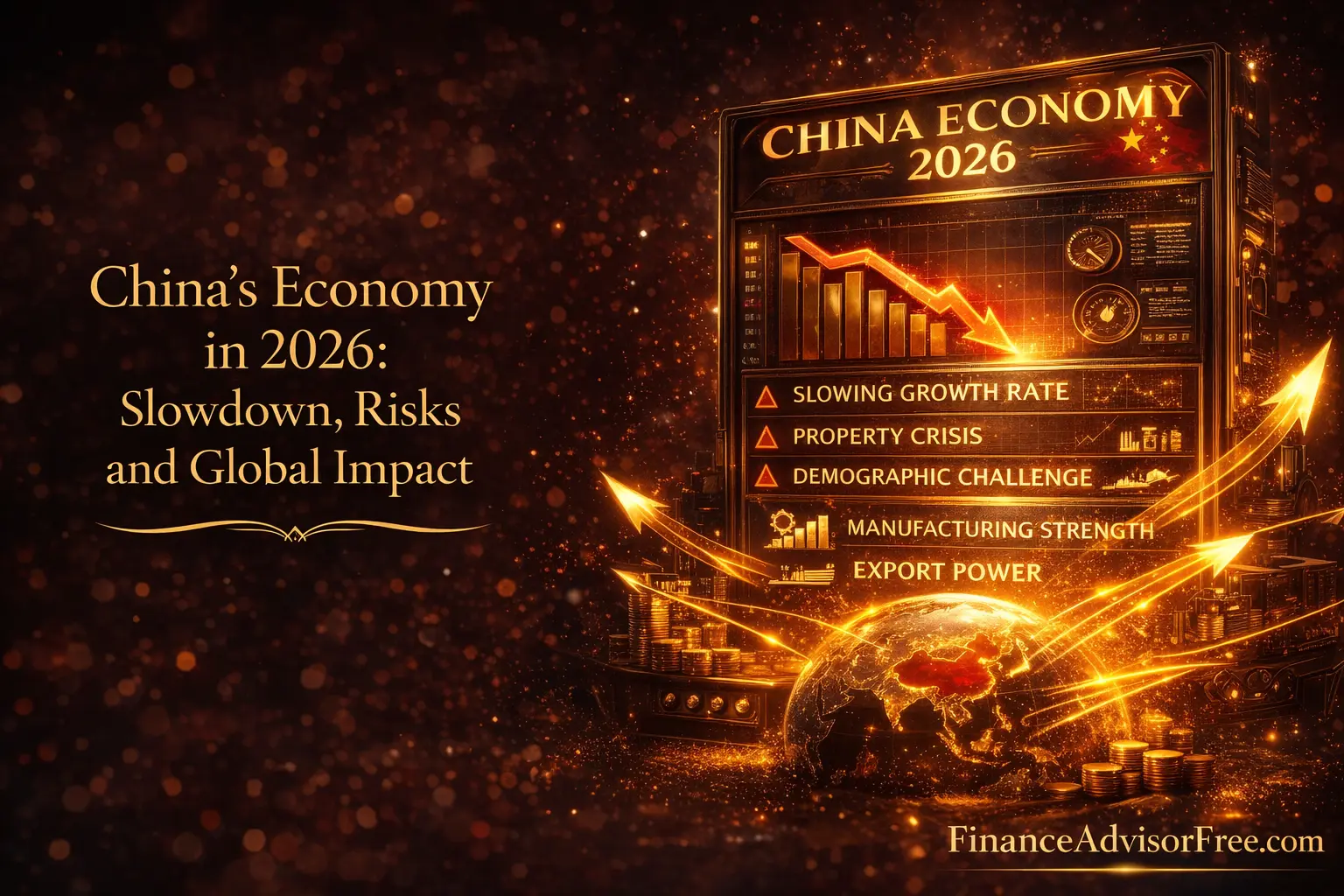
China’s economy in 2026 is navigating the most difficult structural transition in its modern history — moving from a debt-fuelled, investment-driven, property-dependent growth model toward one built on consumption, technology, and higher-value manufacturing. The old model delivered extraordinary results: China grew from 4% of global GDP in 1980 to nearly 18% today, lifting hundreds of millions out of poverty in what remains the fastest sustained economic development in recorded history. But the same model that produced those results — massive infrastructure investment, a property sector that accounted for 25% of GDP at its peak, state-directed credit expansion, and export-led manufacturing — has created structural imbalances that are now unwinding simultaneously, producing the most complex economic environment China has faced since the reform era began. Understanding what is actually happening — beyond the headlines — is essential for any investor with global exposure.
💡 Also in this cluster:
The US-China Economic Rivalry — How the World’s Two Biggest Economies Are Decoupling
Japan’s Lost Decades — What Happened, Why It Matters and Whether It Could Happen in America
The Property Crisis — The Central Challenge
No factor shapes China’s economic outlook in 2026 more than the property sector crisis that erupted with Evergrande’s collapse in 2021. At its peak, Chinese real estate and related industries accounted for approximately 25–30% of GDP — an extraordinary concentration that made the sector simultaneously the primary driver of growth and the most significant systemic vulnerability. When the government began restricting developer borrowing through the “three red lines” policy in 2020, it triggered a cascading collapse in developer financing that has reverberated through the economy for four years.
The scale of the problem is staggering. Dozens of major Chinese property developers have defaulted, been restructured, or stopped servicing their debts. Millions of pre-sold apartments remain unfinished, trapping homebuyers who paid in full and are still waiting for delivery. Property prices in most Chinese cities have declined significantly — by 20–40% in many markets — destroying wealth for a population that has historically held 70–80% of its assets in real estate. Local government finances, heavily dependent on land sales to developers, have been severely stressed, cutting funding for public services and infrastructure investment.
GDP growth target: ~5% (official); actual: ~4.5–5.0%
Property sector as % of GDP (2026): ~15% (down from ~25% peak)
Youth unemployment (under 25): ~15–18% (official; real may be higher)
Consumer price inflation: ~0.5–1.5% (deflationary pressure)
Total debt-to-GDP (government + corporate + household): ~300%+
Population growth: Negative — China’s population peaked in 2022
Foreign direct investment inflows (2024): Down ~25% from 2022 peak
The Demographic Time Bomb
Underlying the cyclical property crisis is a structural demographic challenge that no policy can fully reverse. China’s total fertility rate has fallen to approximately 1.0 — among the lowest in the world — a direct consequence of the one-child policy maintained from 1980 to 2015. China’s population peaked in 2022 and is now declining. The working-age population is shrinking, the ratio of workers to retirees is deteriorating rapidly, and the pension system faces funding gaps that will consume increasing fiscal resources over the coming decades.
Demographics matter for economic growth because a declining workforce mechanically reduces potential output growth unless offset by productivity improvements. Japan’s experience provides the most relevant cautionary example: demographic decline combined with balance sheet deleveraging following an asset price bust produced two decades of near-zero growth. China faces a similar constellation — falling fertility, an aging population, and asset price deflation following credit excess — though from a lower income base that provides more room for productivity catch-up.
Where China Is Succeeding — The New Economy
China’s economic difficulties should not obscure the genuine areas of strength and technological progress that distinguish it from a simple story of decline. In several critical industries, Chinese companies have achieved world-class competitive positions that create significant long-term economic value.
Electric vehicles represent China’s most spectacular industrial success of the 2020s. BYD overtook Tesla as the world’s largest EV seller by volume in 2023, and Chinese automakers — BYD, NIO, Li Auto, SAIC, Geely — now produce vehicles that are competitive on quality and significantly undercut global peers on price. Chinese EV exports have surged, reaching European, Southeast Asian, and emerging market consumers at prices that domestic automakers cannot match. This success reflects a decade of policy support, massive battery manufacturing investment, and the development of a complete domestic supply chain from raw materials to finished vehicles.
Renewable energy manufacturing is another area of extraordinary strength. China produces approximately 80% of the world’s solar panels, 70% of wind turbines, and dominates the lithium-ion battery supply chain. These positions make China indispensable to global decarbonisation efforts regardless of geopolitical tensions, and generate significant export revenue even as Western nations try to reduce dependence on Chinese supply chains for other goods.
Deflation — The Unexpected Risk
While Western economies spent 2021–2023 fighting inflation, China has faced the opposite problem: deflationary pressure. Consumer prices have been flat or slightly negative for extended periods, producer prices have fallen significantly, and the classic deflationary psychology — consumers delay purchases expecting prices to fall further, businesses delay investment expecting weaker demand — has taken hold in ways that complicate the government’s stimulus efforts.
Deflation in China matters globally because Chinese factories export deflationary pressure to the world. When Chinese manufacturers face weak domestic demand and excess capacity, they cut export prices to maintain volumes — which pushes down import prices in destination markets. This “China deflation export” has been a meaningful disinflationary force in global goods prices in 2024–2026, partially offsetting inflation in services and helping Western central banks bring headline inflation toward their targets.
What China’s Slowdown Means for Global Markets
China’s economic trajectory has direct and material consequences for investors worldwide, even those who hold no Chinese assets directly. The transmission channels are numerous and significant.
Commodity markets feel Chinese economic conditions most immediately. China is the world’s largest consumer of copper, iron ore, aluminium, and most industrial metals, the second-largest oil consumer, and a major buyer of agricultural commodities. When Chinese construction slows — as it has dramatically with the property crisis — demand for steel, cement, copper, and iron ore falls, pushing global commodity prices down. Australian, Brazilian, and Chilean mining companies, which export heavily to China, see earnings compress. Conversely, Chinese EV growth is driving demand for lithium, cobalt, and nickel that benefits producers in South America and the Democratic Republic of Congo.
Global trade patterns are being reshaped as China’s export composition shifts. Lower-value assembly work is moving to Vietnam, Bangladesh, and Mexico. Higher-value Chinese exports — EVs, renewable energy equipment, electronics — are growing and creating new competitive threats to established manufacturers in Germany, South Korea, and Japan. Countries and companies in the path of Chinese industrial competition face difficult strategic choices about how to respond.
| China Economic Trend | Global Market Impact | Investment Implication |
|---|---|---|
| Property sector contraction | Lower demand for industrial metals; deflationary pressure | Commodity producers face headwinds; watch copper/iron ore |
| EV manufacturing dominance | Competitive pressure on European/US automakers | Legacy auto stocks face margin compression; battery metals benefit |
| Deflation export | Lower global goods prices; helps Western inflation control | Western central banks can cut rates sooner; bonds benefit |
| Demographic decline | Slower long-run Chinese growth; reduced global demand driver | India and Southeast Asia become more important growth substitutes |
| Supply chain diversification away from China | Rising investment in Vietnam, India, Mexico | Near-shoring beneficiaries; logistics and industrial real estate |
Investing in China — Risks and Opportunities
Chinese equities trade at historically low valuations relative to earnings — a reflection of the structural headwinds, policy uncertainty, and geopolitical risk premium that investors demand. The MSCI China index has significantly underperformed global equities over the past five years, making China one of the cheapest major markets by conventional metrics.
The risks that justify those low valuations are real. Regulatory risk — the Chinese government’s demonstrated willingness to impose sudden, severe regulatory actions on entire sectors (tech in 2021, education, gaming, property) — creates existential risk for individual companies that Western markets do not regularly impose. Accounting transparency is weaker than in US or European markets, making financial analysis less reliable. Geopolitical risk — particularly around Taiwan — creates tail risks of sanctions or conflict that could make Chinese assets uninvestable for Western institutions. And capital controls mean that foreign investors in Chinese domestic (A-share) markets face restrictions on repatriating funds.
For most retail investors, broad emerging markets funds that include China at market-cap weight — rather than dedicated China funds — provide the most appropriate balance of exposure and risk management. If China’s economy stabilises and reforms succeed, broad EM funds capture the upside. If it deteriorates further, the diversification across India, Southeast Asia, Latin America, and other EM markets limits the damage.
Frequently Asked Questions
Is China’s economy really growing at 5% or are the official numbers unreliable?
China’s official GDP statistics have long been viewed with scepticism by economists, who note that provincial GDP figures frequently sum to more than the national total and that GDP growth rarely deviates far from official targets regardless of underlying conditions. Alternative measures — electricity consumption, freight volume, satellite-derived nighttime light intensity — consistently suggest real growth below official figures during stress periods. In 2026, most independent economists estimate China’s true growth is in the 3.5–4.5% range rather than the official 5% target. This is still significant growth for the world’s second-largest economy, but it represents a meaningful slowdown from the 6–8% growth of the previous decade.
Could China experience a Japan-style lost decade?
The parallels between China 2026 and Japan 1990 are uncomfortable and widely discussed among economists. Both feature a property bubble deflating after credit excess, an aging and shrinking population, a current account surplus economy struggling to boost domestic consumption, and a government reluctant to accept the full write-down of bad debts. Japan’s lost decades resulted from allowing zombie banks and companies to limp along rather than forcing rapid recapitalisation — and there are signs China may be making similar policy choices. The critical difference is that China is still a middle-income country with significant productivity catch-up potential, while Japan was already fully developed when its lost decades began. Whether China can leverage that catch-up potential while managing the debt overhang is the central question for its long-run growth prospects.
Should I reduce my China exposure in my portfolio?
For investors currently holding China through broad EM index funds, the existing market-cap weighting (approximately 25–30% of most EM indices) already reflects significant caution relative to China’s GDP share. Reducing to zero China exposure eliminates both the risks and the potential upside from a policy stimulus-driven recovery — which Chinese policymakers have significant tools to engineer, even if imperfectly. For investors holding dedicated China funds or single-country ETFs, the concentration of country-specific risks argues for diversifying toward broader EM exposure. The most balanced approach: hold China through a diversified EM fund at market weight, avoid concentrated single-country China bets, and monitor the property sector resolution and Taiwan risk environment as key indicators.
This article is for informational purposes only and does not constitute financial advice. Economic data on China involves significant measurement uncertainty. Investment involves risk. Please consult a qualified financial advisor before making investment decisions.