
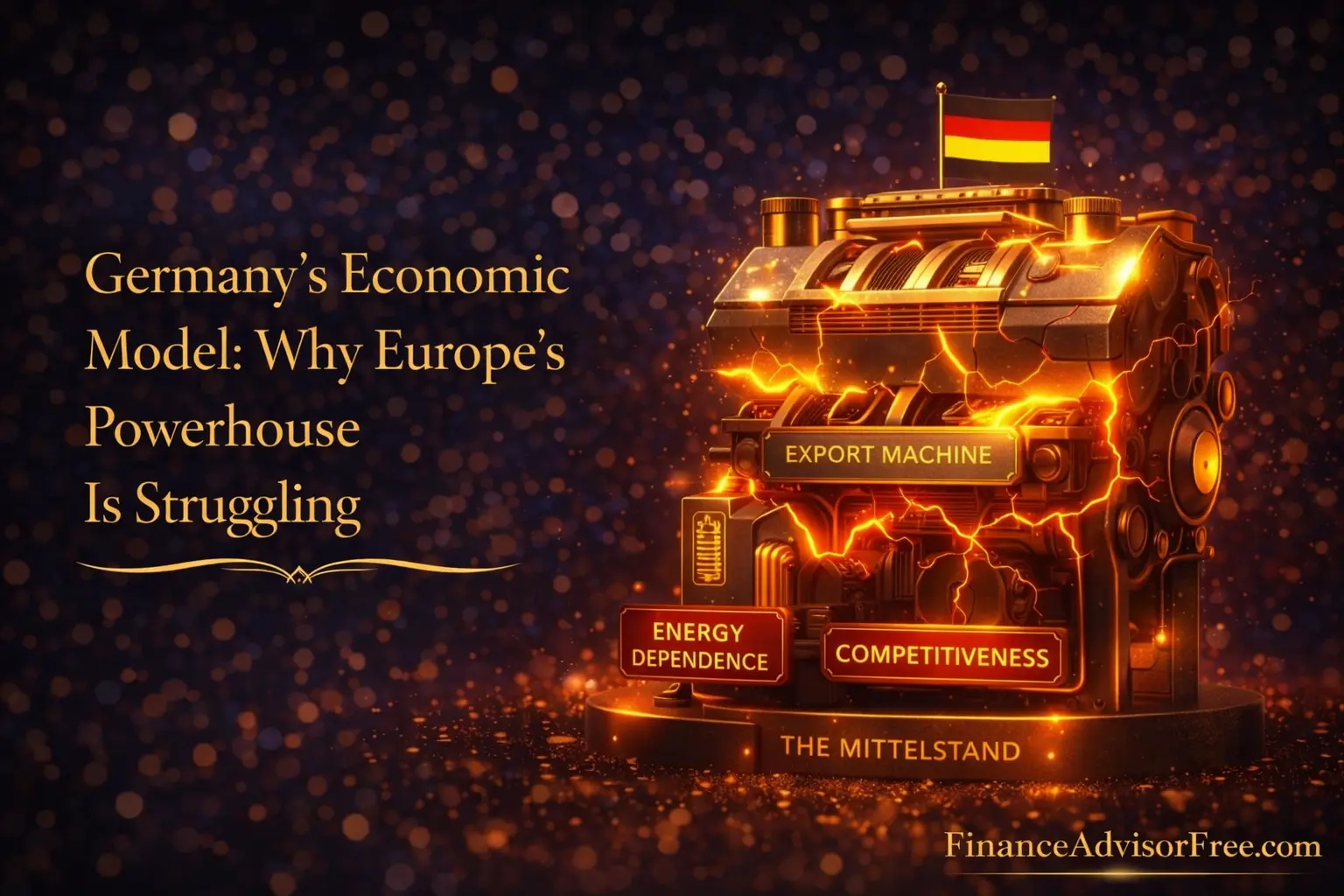
Germany’s economy has been the engine of European prosperity for decades — the industrial powerhouse whose export success, fiscal discipline, and engineering excellence set the standard for developed-market manufacturing competitiveness. Yet in 2026, Germany finds itself in the uncomfortable position of being the slowest-growing major European economy, simultaneously confronting an energy cost crisis, a global automotive transition that threatens its most important industry, Chinese competition in markets it once dominated, and a political environment that has struggled to produce the decisive reforms these challenges demand. Understanding Germany’s economic model — how it became so successful, and why those same strengths are now sources of vulnerability — provides essential context for European investors and anyone seeking to understand the direction of the continent’s largest economy.
💡 Also in this cluster:
The European Economy in 2026 — Challenges, Opportunities and What Investors Should Know
The Euro and the Eurozone — Why a Shared Currency Without a Shared Treasury Is Complicated
The German Model — What Made It Work
Germany’s economic model is built around three interlocking pillars: the Mittelstand, export orientation, and the institutional framework of the social market economy.
The Mittelstand — Germany’s distinctive class of medium-sized, often family-owned industrial companies — is the heart of the German economy. These firms, typically employing between 50 and 5,000 people, dominate highly specialised niches in industrial machinery, automotive components, chemicals, instruments, and engineering where they are often the global market leader in their specific segment. They invest heavily in vocational training, maintain long-term relationships with suppliers and customers, retain earnings conservatively rather than distributing them aggressively, and compete primarily on quality and technology rather than price. The Mittelstand’s combination of deep specialisation, technological excellence, and long-term orientation produced a manufacturing base of extraordinary resilience and competitiveness.
Export orientation amplified Mittelstand strengths into macroeconomic dominance. Germany consistently runs one of the world’s largest current account surpluses — exporting far more than it imports — reflecting the global demand for German industrial goods, automotive products, and chemical products. This surplus has been a source of both German pride and persistent international friction, with critics — including the IMF and US Treasury — arguing that Germany’s surplus reflects insufficient domestic demand rather than pure export excellence, and that it contributes to global imbalances.
GDP: ~$4.5 trillion (3rd globally in nominal terms)
GDP growth (2026): ~0.5% — slowest among major EU economies
Unemployment: ~3.0% — among Europe’s lowest
Trade surplus: ~$200–250 billion annually (current account)
Industrial sector share of GDP: ~23% (vs ~11% in US, ~14% in UK)
Automotive sector share of German GDP (direct + indirect): ~5%
Electricity price for industry (2026): ~150–180 EUR/MWh vs ~60 EUR/MWh pre-Ukraine crisis
The Automotive Crisis — Germany’s Most Acute Challenge
The automobile industry is Germany’s most important economic sector — directly and indirectly accounting for approximately 5% of GDP and employing nearly 800,000 people. Volkswagen, BMW, Mercedes-Benz, and Porsche represent globally recognised brand excellence and generate profits that support vast supplier ecosystems. For most of the postwar era, German automakers were the gold standard of quality, reliability, and engineering sophistication.
The electric vehicle transition has disrupted this position more severely than almost any other challenge in German automotive history. German automakers built their competitive advantage over decades around internal combustion engine engineering — precision machining, fuel efficiency optimisation, powerplant refinement — that is largely irrelevant in electric vehicles. The competitive advantages that made German ICE vehicles superior do not transfer to EVs in the same way. Battery technology, software integration, and supply chain efficiency — the capabilities that determine EV competitiveness — are areas where Chinese and American competitors have built significant leads.
Volkswagen’s announcement in 2024 that it was considering closing German factories for the first time in its history — previously unthinkable in Germany’s consensus-oriented industrial relations system — illustrated the severity of the challenge. The combination of higher production costs (energy, labour, regulation) and intensifying Chinese EV competition in export markets including China itself (where Volkswagen has historically earned a significant share of its profits) has squeezed margins dramatically.
The Energy Shock — A Structural Disadvantage
Germany’s postwar industrial model was built partly on access to cheap energy — initially domestic coal, later Russian natural gas that arrived via pipeline at preferential prices reflecting the strategic commercial relationship between German industry and Russian gas producers. The Energiewende — Germany’s energy transition — was meant to replace fossil fuels with renewable energy while maintaining competitive industrial electricity prices. Russia’s invasion of Ukraine revealed how much Germany had relied on cheap Russian gas to bridge the gap between its renewable energy ambitions and its energy-intensive industrial reality.
Industrial electricity prices in Germany have approximately doubled from pre-crisis levels and remain significantly higher than in the United States, where shale gas has maintained low energy prices, or France, which maintained nuclear power at competitive costs. Chemical plants, aluminium smelters, steel mills, and glass manufacturers — industries that compete globally primarily on cost — face existential questions about whether German-based production remains viable at current energy prices. Several major chemical companies have announced production reductions or facility closures in Germany, with investment redirected to the United States where the Inflation Reduction Act and cheap natural gas provide more attractive conditions.
The Structural Reform Debate — What Germany Needs to Do
The diagnosis of Germany’s challenges is relatively clear among economists: the economy needs to reduce its dependence on energy-intensive, export-oriented manufacturing by growing domestic services and consumption, invest massively in digital infrastructure and skills, accelerate the energy transition to reduce industrial energy costs to competitive levels, and reform its labour and capital markets to attract investment in new sectors. The implementation of this agenda is where German political economy creates obstacles.
Germany’s model of consensus-based governance — the Rhineland capitalism tradition of coordinating major economic decisions through dialogue between government, business, and trade unions — is effective at managing incremental change but poorly suited to the rapid structural transformation the current situation requires. Trade unions have resisted workforce reductions in automotive and chemical industries. The constitutional debt brake (Schuldenbremse) — which limits federal structural deficits to 0.35% of GDP — has constrained the public investment in infrastructure, education, and digital transformation that could accelerate the transition. And political fragmentation — the collapse of the previous coalition government and the rise of populist parties on both left and right — has made decisive legislative action more difficult.
German Companies — World Class Despite Macro Headwinds
It is important not to conflate Germany’s macroeconomic challenges with the quality of its leading companies. German corporate champions in several sectors remain world-class businesses available at reasonable valuations despite the challenging macro environment.
Software AG, SAP (enterprise software), Siemens (industrial automation and digitalisation), Infineon (semiconductors for automotive and industrial), and BASF (specialty chemicals) represent genuine technological and industrial excellence. In healthcare, Bayer, Merck KGaA, and Sartorius provide exposure to pharmaceutical and biotech services demand that is structurally driven by global demographics. In insurance and financial services, Allianz and Munich Re are global leaders in property and casualty insurance and reinsurance.
The investment case for German equities specifically — as distinct from European equities broadly — is most compelling for investors who can identify the companies best positioned to navigate the industrial transformation. Siemens Energy and Siemens Gamesa (wind energy), Infineon (EV power electronics), and industrial automation plays that benefit from global reshoring investment represent Germany’s potential participation in the structural trends reshaping global manufacturing, even if the overall macroeconomic environment remains challenging.
| Sector | Challenge | Opportunity | Key Companies |
|---|---|---|---|
| Automotive | EV transition; Chinese competition; cost disadvantage | Luxury segment resilience; EV component suppliers | BMW, Mercedes-Benz, Infineon |
| Chemicals | High energy costs; US IRA competition | Specialty chemicals with pricing power | BASF, Lanxess, Evonik |
| Industrial automation | Slow German capex; China slowdown | Global reshoring; AI-driven factory automation | Siemens, Kion, Dürr |
| Semiconductors | Cyclical demand; capacity investment costs | EV and industrial power electronics demand | Infineon, Elmos |
| Renewables | Supply chain costs; grid connection delays | German and European energy transition investment | Siemens Energy, RWE |
Frequently Asked Questions
Is Germany in recession in 2026?
Germany has skirted recession throughout 2023–2026, posting quarters of marginally negative and marginally positive GDP growth in succession without meeting the technical definition of two consecutive negative quarters for a sustained period. The more accurate characterisation is stagnation — an extended period of near-zero growth that is not technically a recession but feels like one in terms of industrial output, corporate investment, and consumer confidence. Whether Germany tips into technical recession or ekes out marginal positive growth depends primarily on export demand from China and the rest of the world, energy price developments, and the pace of automotive sector restructuring. The underlying structural challenges persist regardless of whether the GDP print is −0.2% or +0.3% in any given quarter.
Should I invest in German stocks specifically or European stocks broadly?
For most retail investors, European broad-market exposure through funds like the Vanguard FTSE Europe ETF (VGK) or iShares Core MSCI Europe ETF (IEUR) is more appropriate than concentrated German exposure. German equities are available through EWG (iShares MSCI Germany ETF), but single-country concentration amplifies Germany-specific risks without commensurate return enhancement. Europe broadly contains better-performing economies (Spain, the Nordics, parts of Central and Eastern Europe), sectors absent from Germany’s equity market (luxury goods in France, pharmaceuticals across the continent, technology), and currency diversification. If your thesis is that European equities are undervalued relative to the US — a reasonable position given the valuation gap — expressing it through a broad European fund captures that thesis more reliably than a Germany-specific bet.
Will Germany’s automotive industry survive the EV transition?
German automotive will survive but in a significantly different form than today. The luxury segment — BMW, Mercedes-Benz, Porsche — has the brand premium and margin cushion to fund the EV transition while maintaining profitability. Volkswagen’s mass-market and volume brands face more severe competitive pressure from Chinese EV producers offering comparable or superior features at significantly lower prices. The supplier ecosystem — hundreds of companies producing combustion engine components — faces the most acute existential challenge, as EV powertrains require fewer components and different engineering expertise than ICE engines. The transition will involve significant employment displacement in industrial regions, productive capacity closures, and multi-decade restructuring. The question is not survival but the scale and pace of the industrial transformation required.
This article is for informational purposes only and does not constitute financial advice. Economic projections and company assessments involve significant uncertainty. Please consult a qualified financial advisor before making investment decisions.