
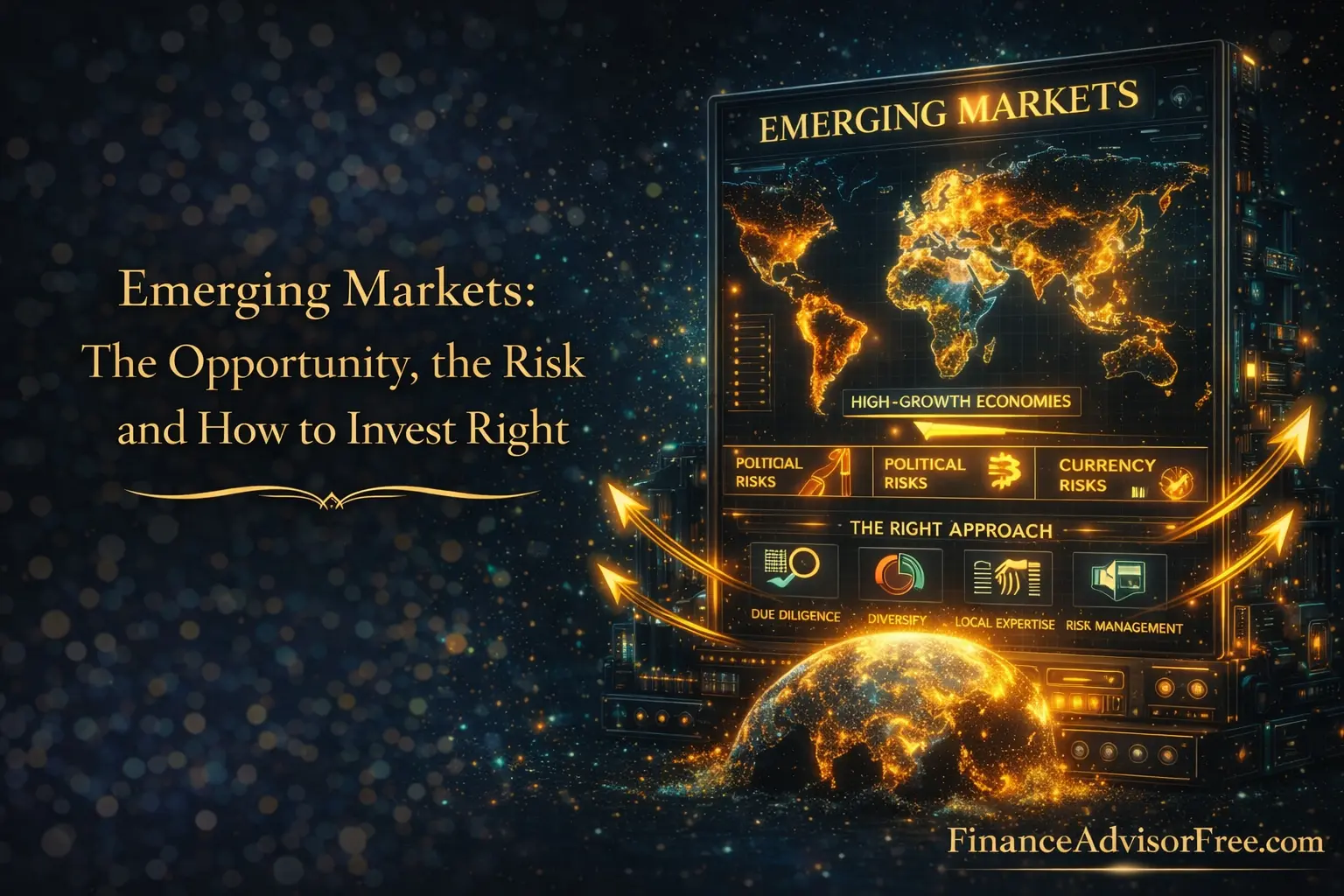
Investing in emerging markets is one of the most compelling — and most misunderstood — strategies available to global investors today. Home to over 80% of the world’s population and generating an increasing share of global GDP, emerging economies offer growth rates that developed markets simply cannot match. Yet with that growth comes a distinct set of risks: currency volatility, political instability, regulatory uncertainty, and liquidity challenges that can catch unprepared investors off guard.
💡 Cluster context: This article is part of our Emerging Markets cluster. To understand the geopolitical forces reshaping global finance, read our analysis of the BRICS bloc and its challenge to Western economic dominance. And for a deep dive into one of the decade’s most important economic stories, see India’s extraordinary rise as a global economic power.
What Are Emerging Markets?
The term “emerging markets” was coined by economist Antoine van Agtmael in 1981 to describe economies in transition — moving from low-income, less developed status toward more industrialized, market-oriented economies. Today, the classification is used by major index providers like MSCI and FTSE Russell to group countries that share certain characteristics: rapid economic growth, improving but still-developing financial markets, and higher risk profiles than developed nations.
The MSCI Emerging Markets Index — the most widely tracked benchmark — currently includes over 20 countries, among them China, India, Brazil, Taiwan, South Korea, Saudi Arabia, and South Africa. These nations are home to some of the world’s largest and fastest-growing companies, including semiconductor giants, e-commerce platforms, and state-owned energy behemoths.
The Growth Case: Why Investors Look to Emerging Markets
Demographic Dividend
Many emerging economies possess what economists call a “demographic dividend” — a large, young, and growing working-age population. Countries like India, Nigeria, Indonesia, and Vietnam are seeing millions of new workers enter their labor forces each year. This fuels consumption, tax revenue, and economic output in ways that aging developed economies simply cannot replicate. A young population also means an expanding middle class, rising consumer spending, and growing demand for financial services, housing, and technology.
Urbanization and Infrastructure Build-Out
Urbanization rates in many emerging economies remain far below those in the developed world. As rural populations migrate to cities, governments and private companies invest heavily in infrastructure — roads, airports, telecommunications networks, power grids, and housing. This investment creates multi-decade growth opportunities across sectors from construction materials to telecom and energy.
Catching-Up Growth
Economies that start from a lower base of productivity and technology can grow faster simply by adopting existing innovations. This “catch-up” dynamic has been observed in South Korea, Taiwan, and now increasingly in Vietnam and India. When a country moves from subsistence agriculture to manufacturing, and then from manufacturing to services, the GDP gains can be enormous and sustained over decades.
The Risks: What Can Go Wrong
For all their appeal, emerging markets carry risks that demand careful attention. Understanding these risks is not a reason to avoid the asset class — but it is essential to managing your exposure wisely.
Currency Risk
When you invest in an emerging market stock or bond denominated in a local currency, your return in dollars (or euros or pounds) is affected not just by the asset’s performance but also by exchange rate movements. Currencies like the Turkish lira, Argentine peso, or Egyptian pound have experienced dramatic devaluations that wiped out years of local-currency gains for foreign investors. Currency hedging is possible but adds cost and complexity.
Political and Regulatory Risk
Governments in emerging markets sometimes take actions that directly harm investors — nationalizing industries, imposing capital controls, changing tax regimes, or cracking down on private enterprise. China’s regulatory campaign against its tech sector in 2021–2022 erased hundreds of billions of dollars in market value from companies like Alibaba and Tencent. Investors who understood only the business fundamentals but not the political context were caught completely off guard.
Liquidity Risk
Many emerging market stocks and bonds trade in thinner markets than their developed-world counterparts. During periods of global stress, investors often rush to exit simultaneously, causing sharp price declines and — in extreme cases — suspension of trading. This “sudden stop” dynamic has triggered multiple financial crises in emerging economies over the decades.
Corporate Governance Risk
Minority shareholder protections are often weaker in emerging markets. State-owned enterprises may prioritize political goals over profit maximization. Related-party transactions, opaque financial reporting, and insider control structures are more common. Diligent due diligence — or selecting well-researched funds — is essential.
Key Emerging Market Regions: An Overview
| Region | Key Countries | Main Growth Driver | Primary Risk |
|---|---|---|---|
| Asia (ex-Japan) | China, India, Taiwan, South Korea, Vietnam | Technology, manufacturing, demographics | Geopolitical tension, regulation |
| Latin America | Brazil, Mexico, Chile, Colombia | Commodities, nearshoring, fintech | Political instability, currency |
| EMEA | Saudi Arabia, South Africa, UAE, Poland | Energy transition, services | Geopolitics, commodity dependence |
| Frontier Markets | Vietnam, Nigeria, Kenya, Bangladesh | Demographics, early-stage growth | Liquidity, governance |
How to Invest in Emerging Markets: A Practical Guide
1. Broad Emerging Market ETFs
For most investors, a low-cost ETF tracking the MSCI Emerging Markets Index is the simplest starting point. Funds like the iShares Core MSCI Emerging Markets ETF (IEMG) or the Vanguard FTSE Emerging Markets ETF (VWO) offer instant diversification across hundreds of companies and dozens of countries for an expense ratio well below 0.2% per year. The trade-off is heavy China exposure and limited flexibility.
2. Regional or Country-Specific ETFs
If you have a view on a particular region or country, dedicated ETFs allow you to express that view. There are ETFs focused on India, Brazil, Southeast Asia, South Korea, and many other markets. This approach allows you to overweight markets you find most compelling while underweighting those with elevated risk.
3. Actively Managed Funds
The informational inefficiencies in many emerging markets create genuine opportunities for skilled active managers. Funds with experienced teams, strong on-the-ground research, and disciplined risk management have historically been able to add value over passive benchmarks in this asset class — though at higher cost and with no guarantee of future outperformance.
4. Direct Stock Investment
Sophisticated investors may choose to buy individual emerging market stocks — either directly on local exchanges or via American Depositary Receipts (ADRs) listed on US markets. ADRs for companies like MercadoLibre, Sea Limited, and HDFC Bank make it relatively straightforward to gain targeted exposure. This approach requires significant research and comfort with company-specific and country-specific risk.
5. Emerging Market Bonds
Emerging market bonds — both sovereign (government) and corporate — offer higher yields than developed market equivalents, reflecting the additional risks involved. They come in two main forms: hard-currency bonds (denominated in US dollars) and local-currency bonds. Dollar-denominated EM bonds avoid currency risk for US investors but are still exposed to sovereign default risk.
Building a Portfolio: How Much Emerging Market Exposure Is Right?
The right allocation to emerging markets depends on your investment time horizon, risk tolerance, and existing portfolio composition. Most financial professionals suggest that long-term investors with a horizon of ten years or more can meaningfully benefit from EM exposure, while those approaching retirement may want to limit their allocation.
A common framework is to start with the global market-cap weight — emerging markets represent roughly 12–15% of the global equity market capitalization — as a neutral baseline. Investors with higher risk appetite and longer time horizons might go to 20–25%. More conservative investors might hold 5–10% or access EM indirectly through multinational companies that earn significant revenues in developing economies.
The Role of Geopolitics in Emerging Market Investing
Geopolitical factors have become increasingly central to emerging market investment decisions. The US–China trade war, Russia’s invasion of Ukraine, and growing tensions over Taiwan have all created sudden and dramatic repricing in affected markets. Supply chain restructuring — with companies shifting manufacturing from China to Vietnam, India, Mexico, and other “China+1” destinations — is creating new winners and losers within the EM universe.
Sanctions risk is another consideration. After Russia’s invasion of Ukraine, Russian stocks were effectively rendered uninvestable for Western investors overnight. Assets that had been part of major indices were written to zero. While Russia is an extreme example, it illustrates how geopolitical events can suddenly invalidate an investment thesis regardless of underlying business fundamentals.
Emerging Markets in 2026: The Current Landscape
As of 2026, the emerging market landscape is shaped by several powerful forces. India has emerged as perhaps the single most compelling long-term growth story, with its combination of demographics, digitalization, and political stability relative to peers. Southeast Asia — particularly Vietnam, Indonesia, and the Philippines — is benefiting from supply chain shifts and a young consumer class. The Gulf states, buoyed by elevated energy revenues and ambitious diversification programs, are becoming increasingly significant players in global capital markets.
China, meanwhile, presents a more complex picture. Its economy continues to grow, but faces headwinds from a property sector crisis, demographic decline, weak consumer confidence, and intensifying geopolitical friction with the West. For many investors, “EM ex-China” strategies have become increasingly popular as a way to capture emerging market growth without the China-specific risks.
Frequently Asked Questions
Are emerging markets too risky for individual investors?
Emerging markets carry genuine risks that individual investors must take seriously — currency swings, political upheaval, and weaker corporate governance are all real concerns. However, these risks can be managed through diversification, long time horizons, and using well-researched funds rather than individual stocks. Many financial advisors recommend that most long-term investors hold at least some EM exposure, calibrated to their personal risk tolerance.
What is the difference between emerging markets and frontier markets?
Frontier markets are a subset of developing economies that are less advanced in their capital market development than emerging markets. Countries like Vietnam (recently reclassified), Nigeria, Bangladesh, and Kenya are often classified as frontier. They offer even higher growth potential but with significantly less liquidity, more limited transparency, and greater political risk than mainstream emerging markets.
How does currency risk affect emerging market returns?
Currency risk is one of the most impactful factors for foreign investors in emerging markets. When an emerging market currency depreciates against the US dollar, your dollar-denominated returns fall even if the local-currency performance of your investment was positive. Conversely, when EM currencies strengthen against the dollar, returns are amplified. Some ETFs offer currency-hedged versions, though hedging adds cost and is most practical over shorter time horizons.
Should I use ETFs or active funds for emerging market exposure?
Both approaches have merit. Low-cost ETFs offer simplicity, transparency, and guaranteed market-rate returns at minimal cost — ideal for investors who want EM exposure without complexity. Active funds can potentially outperform in the less efficient corners of the EM universe, but come with higher fees and manager selection risk. Many sophisticated investors use a “core and satellite” approach — a low-cost ETF as the core, with selective active exposure to specific regions or themes.
This article is for informational and educational purposes only and does not constitute financial, investment, or economic advice. Always consult a qualified financial professional before making investment decisions.