
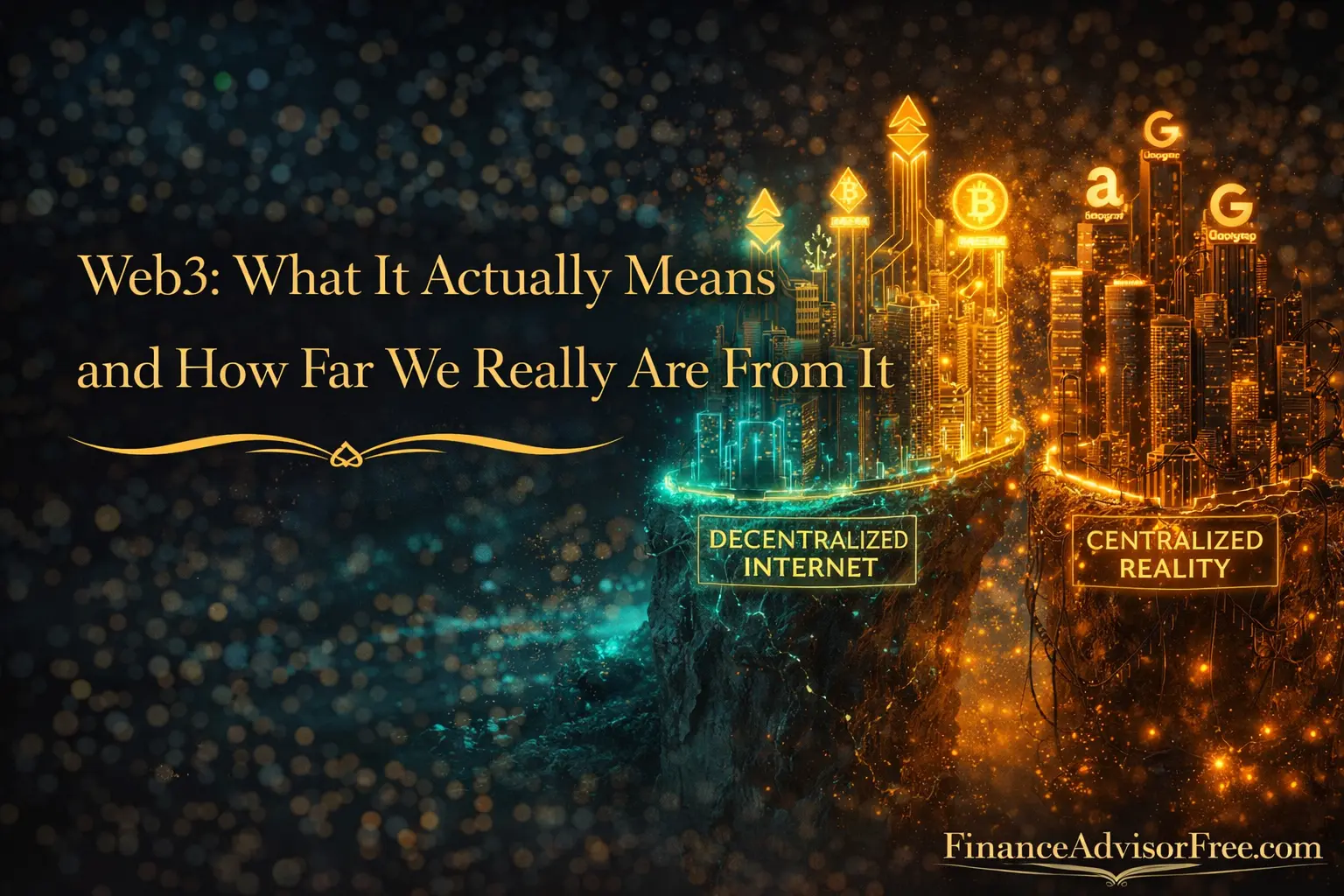
Web3 explained honestly requires separating two very different things that have become entangled in public discourse: the genuine technological vision of a more decentralised internet, and the speculative marketing ecosystem that attached itself to that vision between 2020 and 2023 and produced a significant amount of hype, fraud, and disillusionment. Both things are real. Understanding the difference between them is essential for anyone who wants a clear view of where decentralised internet technology actually stands in 2026 and where it is realistically headed.
💡 Also in this cluster:
How Blockchain Works — The Technology Behind Crypto That Even Non-Technical People Can Understand
Smart Contracts — What They Are, How They Work and What Industries They Will Disrupt
Web1, Web2, Web3: The Evolution in Plain Language
To understand Web3, it helps to understand what came before it — not as a precise technical taxonomy but as a useful description of how the internet’s economic and social model has evolved.
Web1 (roughly 1991–2004) was the read-only internet. Websites were static pages of information created by a relatively small number of producers and consumed by a growing number of readers. The economic model was simple: organisations built websites, people visited them. Interactivity was limited, user accounts were rare, and the internet was largely decentralised by necessity — websites ran on servers owned by their creators, and there was no central authority controlling access to information beyond internet service providers and DNS registrars.
Web2 (roughly 2004–present) is the read-write internet — the internet most people alive today grew up with. Social media, user-generated content, e-commerce, streaming, and app-based services define this era. The critical economic characteristic of Web2 is centralisation: a small number of enormously powerful platforms (Google, Meta, Amazon, Apple, Microsoft) control the majority of internet activity, hold vast quantities of user data, and extract value as intermediaries between users and their content, between buyers and sellers, between advertisers and audiences. You create the content; the platform owns the relationship. You build an audience; the platform owns the algorithm that determines whether your audience sees your work. You store your data; the platform can change its terms of service, shut down your account, or sell your data to third parties.
Web3 is the proposed read-write-own internet — a version of the internet where users control their own data, own their digital assets outright, and interact through decentralised protocols that no single company controls. The ownership layer is provided by blockchain technology: digital assets recorded on a public ledger that you hold in a wallet you control, governed by smart contracts whose rules are transparent and immutable. In Web3, the platform cannot change the terms of service after the fact, cannot confiscate your assets, and cannot extract value from your activity without your explicit consent.
The Core Components of the Web3 Vision
Web3 is not a single technology but a stack of technologies and protocols, each addressing a different aspect of the centralisation problem in today’s internet. Understanding each component separately clarifies both what has been achieved and what remains unsolved.
Decentralised Finance (DeFi)
DeFi is the most mature and most used component of the Web3 ecosystem. Decentralised exchanges, lending protocols, stablecoins, and yield-generating applications collectively process tens of billions of dollars daily on Ethereum and its Layer 2 networks. DeFi demonstrates that financial services can operate without centralised intermediaries, at global scale, with full transparency, and available to anyone with an internet connection. It is not hypothetical — it is operating, generating real revenue, and serving real users. Its limitations (complexity, smart contract risk, regulatory uncertainty, and the fact that most DeFi users are still financially sophisticated crypto natives rather than mainstream consumers) are real but do not diminish the significance of what has been built.
Decentralised Identity
One of the most under-discussed but potentially most significant components of Web3 is self-sovereign identity — the ability for individuals to hold their own verified digital credentials without relying on a centralised issuer. Today, your identity on the internet is largely determined by accounts controlled by platforms: your Google account, your Facebook login, your government portal credentials. Each of these can be revoked, locked, or compromised. A Web3 identity model would allow you to hold a cryptographic credential in your own wallet — issued once by a trusted authority but controlled forever by you — and present it to any service without going through a centralised platform. Projects like ENS (Ethereum Name Service), Worldcoin (iris-based proof of personhood), and the EU’s digital identity framework are working toward this vision with varying degrees of success and controversy.
Decentralised Storage
Today’s internet stores data primarily on the servers of a handful of cloud computing companies — AWS, Google Cloud, Microsoft Azure. A website or application depends on the continued operation and goodwill of these centralised providers. Decentralised storage networks — Filecoin, Arweave, and IPFS (InterPlanetary File System) — distribute data across many independent nodes, making it resilient to any single point of failure and owned by no single company. IPFS in particular has gained significant adoption as the storage layer for NFT metadata, but mainstream adoption for general web content remains limited. The performance and cost characteristics of decentralised storage have improved substantially since 2020 but still lag behind centralised cloud alternatives for most applications.
Decentralised Governance (DAOs)
Decentralised Autonomous Organisations are a governance structure enabled by smart contracts where token holders vote on protocol decisions — treasury allocation, parameter changes, personnel decisions — with results executed automatically by smart contracts. DAOs currently govern most major DeFi protocols, managing billions of dollars in community treasuries. Their limitations are significant: voter participation is often very low, whale token holders have disproportionate influence, and coordinating large decentralised communities on complex decisions is slow and contentious. But the experiment in on-chain governance is ongoing and genuine — a form of organisational structure with no direct precedent in corporate or government history.
| Web3 Component | Maturity Level | Current Users | Key Challenge | Mainstream Timeline |
|---|---|---|---|---|
| DeFi (finance) | High — live at scale | ~5–10 million active | Regulation, UX complexity | 3–7 years |
| NFTs / Digital Ownership | Medium — post-hype stabilisation | ~3–5 million active | Use case clarity, speculation stigma | 5–10 years |
| Decentralised Identity | Early — pilots and experiments | <1 million active | Regulatory recognition, UX | 7–15 years |
| Decentralised Storage | Early–Medium | Developer-focused | Performance vs centralised | 7–15 years |
| DAO Governance | Experimental — ongoing | ~2 million token holders | Participation, plutocracy risk | 10+ years |
| Decentralised Social Media | Very early | <500,000 active | Network effects, UX | 10–20 years |
What Web3 Has Actually Achieved by 2026
Separating genuine progress from hype requires a specific accounting of what actually works today, serving real users with real money at stake. DeFi protocols handle real economic activity without custodians or intermediaries — this is demonstrated fact, not aspiration. Stablecoins built on Ethereum rails process billions of dollars daily in cross-border payments and settlement — demonstrably more efficient than many traditional correspondent banking routes. NFTs have established functioning digital ownership records for art, gaming items, and event tickets — flawed and over-hyped, but technically working. ENS domains give Ethereum wallets human-readable names that their owners control without relying on a registrar that can confiscate the domain. Decentralised social protocols like Lens and Farcaster have small but real user bases who own their social graph independent of any platform.
The Honest Limitations: Why Web3 Is Still Far Away for Most People
Intellectual honesty requires acknowledging that despite genuine progress, the version of Web3 its proponents envisioned — a decentralised internet used by billions — remains far from realisation in 2026. Several structural challenges have proven more persistent than early optimists predicted.
The UX Problem
Using Web3 applications requires managing a crypto wallet, understanding seed phrases, paying gas fees, navigating between different networks, and taking personal responsibility for security that a single mistake can make catastrophic and permanent. The cognitive load is orders of magnitude higher than using a Web2 application — and Web2 applications were already considered too complex by a significant portion of the population. The gap between the technical capabilities of Web3 and the UX that mainstream consumers would accept is large and has proven stubbornly difficult to close. Account abstraction — a technical upgrade that allows wallets to function more like traditional accounts, with password recovery, transaction batching, and other user-friendly features — is promising but has not yet transformed mainstream accessibility.
The Centralisation Irony
Much of the Web3 ecosystem runs on infrastructure that is itself centralised. The majority of Ethereum nodes are hosted on Amazon Web Services. MetaMask — the most widely used Ethereum wallet — at one point displayed a banner acknowledging it was partially running on Infura, a centralised API provider. Many NFT projects store their images on centralised servers, meaning the NFT is a blockchain record pointing to an image that could disappear if the company hosting it shuts down. Chainlink oracles, though distributed, have a layer of governance concentration. The irony that a movement dedicated to decentralisation relies heavily on centralised infrastructure is not lost on thoughtful observers — it reflects the practical difficulty of building purely decentralised alternatives that match the performance and reliability of centralised systems.
The Regulatory Uncertainty
Web3’s permissionless, pseudonymous characteristics are precisely what regulators find most challenging. AML and KYC requirements that apply to financial services are difficult to implement in protocols with no central operator. Securities regulations may apply to governance tokens in ways that their issuers did not anticipate. Data protection regulations conflict with blockchain immutability. The regulatory environment has become clearer in some jurisdictions since 2023 — the EU’s MiCA framework, the UK’s crypto regulatory regime, and evolving US guidance have all provided more clarity than existed during the 2021–2022 peak. But compliance uncertainty continues to deter mainstream institutional participation in many Web3 applications.
Where Web3 Is Most Likely to Succeed
The applications most likely to achieve mainstream success are those where Web3’s specific properties — censorship resistance, permissionless access, user-owned assets, and transparent rules — solve a genuine problem that centralised alternatives cannot solve as well. Financial inclusion for the unbanked (over 1.4 billion people globally lack bank accounts but increasing numbers have smartphones), cross-border payments and remittances, digital ownership of gaming assets that persist across platforms, creator monetisation without platform rent-extraction, and verifiable identity for people in countries with corrupt or absent state infrastructure are all areas where the Web3 value proposition is genuinely compelling relative to alternatives.
The Likely Path: Gradual Infrastructure, Not Revolution
The most realistic trajectory for Web3 in 2026 and beyond is gradual infrastructure penetration rather than the dramatic consumer-facing revolution that was promised during the 2021 peak. Stablecoin payment rails are already being adopted by businesses for cross-border settlement. Central bank digital currencies — government-issued digital currencies running on distributed ledger technology — are being rolled out or piloted in dozens of countries. Tokenised real-world assets (bonds, funds, commodities represented as blockchain tokens) are being issued by major financial institutions including BlackRock, JPMorgan, and Franklin Templeton. These are not consumer-facing Web3 applications — they are institutional adoption of blockchain infrastructure that operates largely invisibly to end users. The consumer-facing decentralised internet remains further away.
Frequently Asked Questions
Is Web3 the same as the metaverse?
No — they are related concepts that were frequently conflated during the 2021 hype cycle but are distinct. Web3 refers to a decentralised internet architecture where users own their digital assets and data, governed by blockchain protocols. The metaverse refers to persistent, immersive virtual environments where people work, socialise, play, and transact — a concept closer to science fiction like Ready Player One than to any current technology. Some metaverse projects use Web3 technologies (blockchain-based land ownership, NFT avatars, cryptocurrency economies), but the metaverse concept does not require blockchain, and Web3 encompasses far more than virtual reality environments. The metaverse narrative peaked with Meta’s rebranding in 2021 and has since retreated significantly as the technology proved far less immersive and far less used than anticipated. Web3 as a broader technology ecosystem has proven more durable, even if its most speculative applications (including many metaverse projects) have not.
Do I need cryptocurrency to use Web3?
In most current Web3 applications, yes — you need cryptocurrency to pay transaction fees, interact with smart contracts, and hold blockchain-based assets. This is one of the primary barriers to mainstream adoption. Account abstraction and “sponsored transactions” — where application developers pay gas fees on behalf of users — are beginning to make it possible to use certain Web3 applications without holding cryptocurrency, with the user experience resembling a conventional web application. Several major Web3 wallets now support gasless transactions for specific applications. As these technologies mature, it will become increasingly possible to benefit from Web3’s ownership and censorship-resistance properties without needing to manage cryptocurrency directly. Full abstraction of the underlying blockchain complexity from end users is probably 5–10 years away at mainstream scale.
Is Web3 good for privacy?
This is nuanced. Public blockchains are by design transparent — every transaction is visible to everyone, permanently. This is good for verifiability and accountability but poor for privacy. While wallet addresses are pseudonymous (not directly linked to real identities without additional information), blockchain analytics companies have become very sophisticated at tracing transaction flows and linking addresses to identities through on and off-ramp activity at exchanges. In practice, public blockchain activity is far less private than cash and significantly less private than most people assume. Zero-knowledge proof technologies — mathematical techniques that allow you to prove you meet a condition without revealing the underlying data — offer a potential solution, enabling private transactions on public blockchains. Zcash, Aztec Network, and various ZK-based privacy protocols address this. But private blockchains and privacy-preserving features remain niche in 2026, and regulatory pressure from AML authorities pushes in the opposite direction from privacy enhancement.
Will Big Tech companies adopt Web3?
The relationship between established technology companies and Web3 is complex and evolving. Major financial institutions — BlackRock, JPMorgan, Fidelity, Franklin Templeton — have adopted blockchain technology for tokenised assets, stablecoin settlement, and digital fund infrastructure, representing perhaps the most significant institutional validation of Web3 concepts. Traditional tech giants have been more cautious: Meta’s pivot to the metaverse has reversed, Apple maintains tight control over its platforms and has been hostile to crypto payment integration, Google has allowed crypto app distribution while maintaining distance from blockchain infrastructure. A more likely scenario than Big Tech “adopting Web3” is the continued growth of Web3 infrastructure alongside traditional internet platforms — serving complementary rather than overlapping use cases, gradually intersecting as regulatory frameworks clarify and user experiences improve, but not displacing centralised platforms in any near-term timeframe.
This article is for informational purposes only and does not constitute financial or investment advice. Web3 technologies and regulatory frameworks are evolving rapidly. Please consult a qualified financial advisor before making any investment decisions related to cryptocurrency or blockchain-based assets.