
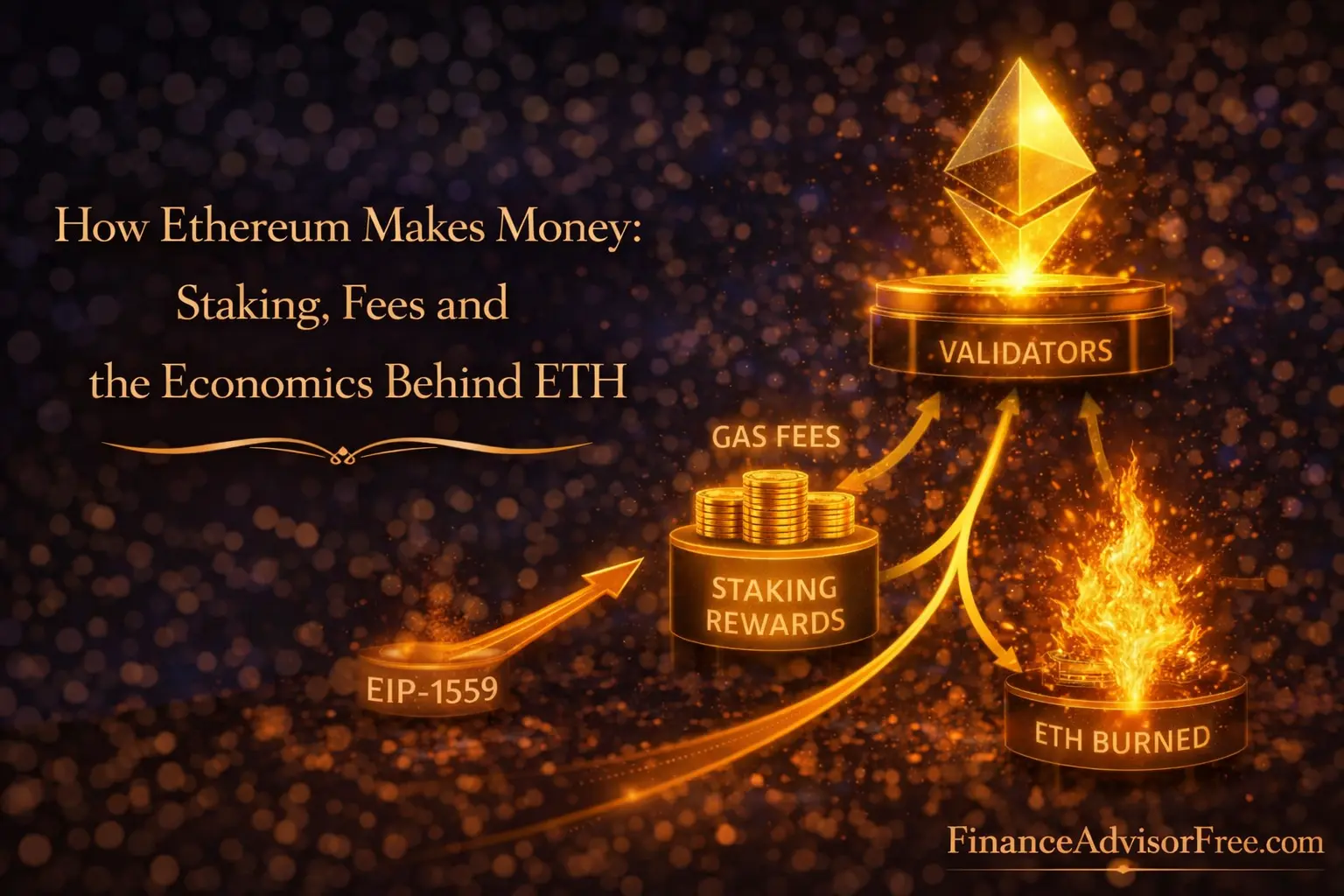
Understanding how Ethereum makes money — or more precisely, how value flows through the Ethereum network and accrues to ETH holders — is the key to understanding why many investors and analysts treat ETH as a fundamentally different type of asset from Bitcoin. Unlike Bitcoin, which derives its value primarily from scarcity, Ethereum has an economic model that resembles, at least in some respects, a productive asset: it generates fee revenue, it rewards participants who secure the network, and it has a mechanism that reduces its own supply in proportion to how heavily the network is used.
💡 Also in this cluster:
Ethereum Explained — What Smart Contracts Are and Why They Matter Beyond the Price
Ethereum vs Bitcoin — Two Very Different Bets on the Future of Money
The Three Pillars of Ethereum’s Economic Model
Ethereum’s economics rest on three interconnected mechanisms: transaction fees paid by users to use the network, staking rewards paid to validators who secure it, and the fee-burning mechanism introduced by EIP-1559 that permanently removes ETH from circulation. Understanding how these three components interact — and how they balance each other — is the foundation for understanding Ethereum’s value proposition as an asset, not just as a technology.
Transaction Fees: The Revenue of the Network
Every interaction with the Ethereum blockchain — sending ETH, executing a smart contract, swapping tokens on a decentralised exchange, minting an NFT — requires paying a transaction fee denominated in ETH. These fees, measured in units called “gas,” compensate the validators who process and verify transactions, and they fluctuate dynamically based on how congested the network is at any given moment.
How Gas Fees Are Calculated
Since the EIP-1559 upgrade in August 2021, Ethereum’s fee structure has two components: a base fee and a priority fee (tip). The base fee is set algorithmically by the protocol, adjusting automatically based on how full recent blocks have been. If blocks are more than 50% full, the base fee rises; if they are less than 50% full, it falls. This mechanism smooths out fee spikes and makes fees more predictable for users. The priority fee (tip) is an optional additional amount users pay to incentivise validators to include their transaction sooner during periods of high demand. Users who are not in a hurry can set a low or zero tip and wait; users who need immediate inclusion pay a higher tip.
The critical innovation of EIP-1559 is what happens to the base fee: it is not paid to validators. It is burned — permanently destroyed, removed from the ETH supply forever. Only the tip goes to validators. This seemingly technical detail has profound economic implications.
Fee Revenue Scale
At peak periods of network activity, the Ethereum ecosystem generates tens of millions of dollars in daily fee revenue. Even in quieter periods, daily fees across mainnet and the major Layer 2 networks collectively represent a substantial ongoing revenue stream — one that, if Ethereum were structured as a company, would make it one of the most valuable financial services businesses in the world by revenue-to-valuation metrics. This “protocol revenue” framing — treating Ethereum’s fee income the way one might treat a company’s revenue — is how some analysts approach ETH valuation, though it is important to note that ETH is not a security and confers no legal claim on this revenue.
Staking: How Ethereum Pays Its Validators
Since the Merge in September 2022, Ethereum’s network is secured not by miners expending electricity, but by validators who lock up ETH as collateral — a process called staking. In exchange for performing validation duties (proposing blocks, attesting to the validity of other validators’ blocks, participating in the consensus process), validators earn ETH rewards. These rewards come from two sources: newly issued ETH (the protocol’s “inflation” mechanism) and the priority fees (tips) paid by users on every transaction.
The Staking Yield
The annual staking yield — the percentage return validators earn on their staked ETH — is not fixed. It is determined by the total amount of ETH staked across the network: the more ETH staked, the lower the per-validator yield, since the same pool of rewards is shared among more participants. In 2026, with approximately 30 million ETH staked, the base staking yield is approximately 3–4% annually, with variations depending on network activity and tip revenue. This yield is paid in ETH — meaning the real return in fiat terms depends on ETH’s price movements.
How to Stake Ethereum
Direct staking requires exactly 32 ETH (approximately $80,000–$120,000 at typical 2026 prices) and running a validator node — a 24/7 connected computer that participates in the consensus process. This is feasible for technically capable individuals with sufficient capital, but out of reach for most retail investors. The alternatives are more accessible. Liquid staking protocols — primarily Lido Finance (stETH), Rocket Pool (rETH), and Coinbase (cbETH) — allow users to stake any amount of ETH and receive a liquid token representing their stake plus accrued rewards, which can be used in DeFi while earning staking yield simultaneously. Exchanges including Coinbase, Kraken, and Binance offer custodial staking with lower minimums and no technical requirements, at the cost of a platform fee that reduces the effective yield.
| Staking Method | Minimum ETH | Technical Requirements | Approximate Yield | Custody | Liquidity |
|---|---|---|---|---|---|
| Solo Validator | 32 ETH | High (run your own node) | ~3.5–4% | Self-custody | Locked (unstake process ~days) |
| Lido Finance (stETH) | Any amount | None | ~3–3.5% | Non-custodial (smart contract) | Liquid (tradeable token) |
| Rocket Pool (rETH) | Any amount | None | ~3–3.5% | Non-custodial (smart contract) | Liquid (tradeable token) |
| Coinbase (cbETH) | 0.001 ETH | None | ~2.5–3% | Custodial (Coinbase) | Liquid (tradeable token) |
| Exchange Staking (Kraken, Binance) | Very low | None | ~2–3% | Custodial (exchange) | Varies by platform |
EIP-1559 and the Deflationary Mechanism
EIP-1559 (Ethereum Improvement Proposal 1559) was activated in August 2021 and introduced one of the most discussed economic mechanisms in cryptocurrency: the automatic burning of the base fee portion of every transaction. Before EIP-1559, all transaction fees went to miners. After EIP-1559, the base fee — which represents the majority of fees in normal market conditions — is permanently destroyed. Only the user-specified tip goes to validators.
When Ethereum Becomes Deflationary
The relationship between burn rate and issuance rate determines whether ETH’s total supply is growing or shrinking at any given moment. When network activity is low and fees are minimal, the burn rate falls below the issuance rate, and the total supply of ETH grows slowly (inflationary). When network activity is high — during DeFi seasons, NFT booms, token launches, or major market events — the burn rate exceeds the issuance rate, and the total supply of ETH decreases (deflationary). This creates a dynamic where high usage of the Ethereum network directly benefits ETH holders by reducing supply — a mechanism that has no equivalent in Bitcoin’s model, which has no fee burning at all.
The "Ultrasound Money" Thesis
Bitcoin proponents describe BTC as "sound money" because of its fixed supply of 21 million coins. Ethereum advocates have coined the term "ultrasound money" to describe what they see as an even more compelling monetary property: not just a fixed supply cap, but a supply that can actively shrink when the network is heavily used. The argument is that while Bitcoin's supply grows at a predictable but positive rate until 2140, Ethereum's supply can decrease — and the more value the network creates, the more ETH is burned and the scarcer it becomes.
This is a philosophically interesting argument, but it is worth examining critically. Ethereum's supply is not actually capped — it can grow when activity is low. The deflationary property is conditional on sustained network usage. And the "ultrasound money" framing was largely developed by ETH advocates with a vested interest in the narrative's success. What is unambiguously true is that EIP-1559 created a mechanism that links network usage to supply reduction — a novel economic design that has no direct precedent in monetary history, and whose long-term implications are still being understood.
How Layer 2 Networks Affect Ethereum's Economics
The growth of Layer 2 networks has been both Ethereum's greatest scaling success and a source of tension in its economic model. Layer 2 networks dramatically reduce gas costs for users — which is the goal — but lower mainnet fees mean less ETH is burned per transaction, reducing the deflationary pressure on supply. As more activity migrates to Layer 2s, Ethereum mainnet fees (and therefore burns) are lower than they would be if all activity remained on mainnet.
The Ethereum community's response to this tension has focused on "blobs" — a new data storage format introduced in the Dencun upgrade (March 2024) that allows Layer 2 networks to post their transaction data to Ethereum mainnet much more cheaply. This dramatically reduced Layer 2 fees for end users. The trade-off is that blob fees contribute less to burn than full transaction fees did. In 2026, the community continues to navigate the balance between scaling (lower fees, more users) and fee economics (higher burns, better ETH supply dynamics) — a tension with no simple resolution.
Frequently Asked Questions
Do I earn ETH just by holding it?
No — simply holding ETH in a wallet does not generate any return. To earn staking rewards, you must actively participate in the staking process, either by running your own validator node, depositing ETH into a liquid staking protocol, or using an exchange's staking service. The distinction matters because ETH is sometimes compared to a dividend-paying stock — but only staked ETH generates yield, not held ETH. If you hold ETH without staking it, you are missing the yield that stakers earn, which means your relative position within the ETH ecosystem is being diluted by approximately 3–4% annually compared to those who are staking. This opportunity cost is worth considering when deciding whether to stake and which method to use.
Is the ETH staking yield guaranteed?
No. The staking yield is determined dynamically by the protocol based on the total amount of ETH staked and the volume of transaction fees generated. Both of these factors change over time. If the total amount of staked ETH increases significantly (which it has been doing gradually), the per-validator yield decreases. If network activity falls and fee revenue drops, the tip component of staking rewards shrinks. The base issuance yield is more predictable, but the total yield including tips varies considerably with market conditions. Validators also face the risk of "slashing" — a penalty for certain types of misbehaviour — and the operational risk of validator downtime, which incurs small penalties for missed attestations. Staking rewards are denominated in ETH, not in fiat currency, so the dollar value of those rewards is subject to ETH price movements.
What happens to ETH staking if regulations tighten?
Regulatory treatment of ETH staking varies by jurisdiction and has been evolving rapidly. In the United States, the SEC has at times suggested that staking services offered by centralised exchanges may constitute unregistered securities offerings — Kraken settled with the SEC in 2023 over its US staking service, and other exchanges have faced similar scrutiny. In the EU, MiCA provides a clearer framework that distinguishes between different types of staking services. Protocol-level staking — running your own validator — is generally considered less susceptible to regulatory classification as a security offering, since it involves no intermediary. Liquid staking protocols exist in a regulatory grey area that varies by jurisdiction. If you are staking significant amounts through a centralised exchange or liquid staking service, monitoring regulatory developments in your jurisdiction is an important part of managing this risk.
How does Ethereum's economic model compare to a traditional business?
The comparison to a business is useful but imperfect. Ethereum generates real revenue in the form of transaction fees — approximately $1–5 billion annually across periods of varying activity. A portion of this revenue is distributed to validators (analogous to labour costs and operating expenses), and a portion is burned (analogous to share buybacks in corporate finance, which reduce the outstanding share count and benefit remaining shareholders proportionally). ETH holders benefit from supply reduction through burns similarly to how equity holders benefit from buybacks. The key difference is that ETH is not a security — holding it confers no legal right to revenue, no governance rights over the protocol, and no claim in liquidation. The economic analogies are intellectually useful for valuation frameworks, but they should not be confused with the legal and financial rights that come with actual equity ownership.
This article is for informational purposes only and does not constitute financial or investment advice. Staking yields, protocol mechanics and regulatory status described are subject to change. Please consult a qualified financial advisor before making any investment decisions.