
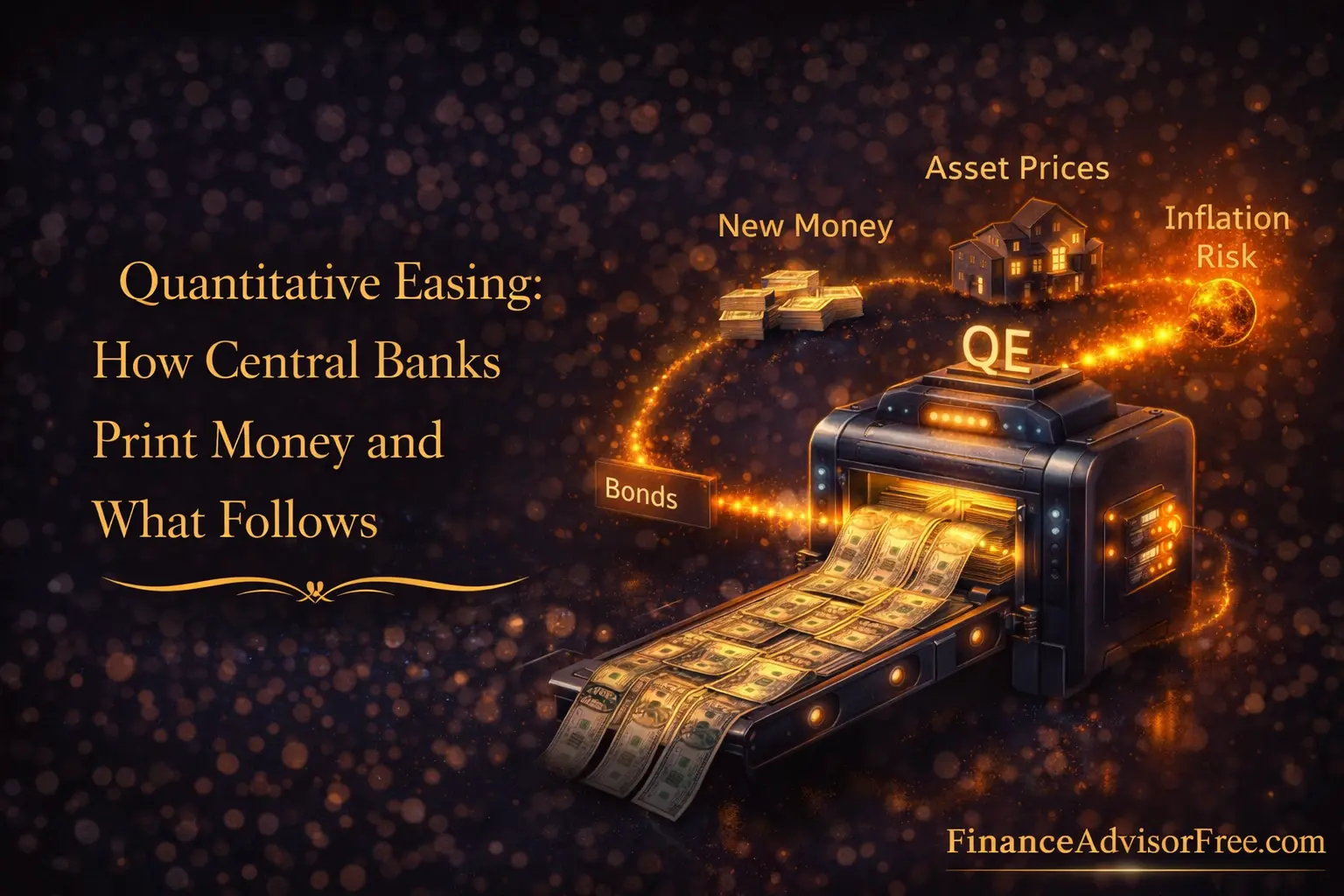
Quantitative easing explained simply: it’s what central banks do when cutting interest rates to zero isn’t enough — they start buying massive quantities of financial assets to inject money directly into the economy. It sounds radical, and it is. But since 2008, it has become standard policy for the world’s most powerful central banks.
💡 Cluster context: QE is one of the Fed’s most powerful — and controversial — tools. To understand the institution that deploys it, start with How the Federal Reserve Works, which explains the full structure and mandate behind these decisions. And if you want to know how to respond to these policy moves as an investor or borrower, see Federal Reserve Interest Rate Decisions.
Why QE Exists — The Problem It Was Designed to Solve
Central banks normally manage the economy through interest rates. Cut rates, and borrowing gets cheaper; spending and investment pick up; the economy grows. It’s a clean mechanism — until rates hit zero.
When rates reach zero (or close to it), the traditional tool runs out of room. You can’t cut a rate from 0% to -2% and expect mortgage borrowers to behave normally. Negative interest rates create strange incentives and, in practice, have limited effectiveness. Central banks needed another tool for the moments when cutting rates to zero still wasn’t enough to prevent a deep recession.
That tool is quantitative easing: instead of changing the price of money (the interest rate), the central bank changes the quantity of money — by creating new reserves and using them to buy financial assets.
How QE Actually Works — Step by Step
QE is often described as “printing money,” which is technically inaccurate but captures the intuition. Here’s what actually happens:
Step 1: The FOMC decides to purchase a specific quantity of assets — typically U.S. Treasury bonds and mortgage-backed securities (MBS). It announces the amount and the pace of purchases.
Step 2: The New York Federal Reserve, acting as the operational arm, purchases these securities from large financial institutions — primarily banks and primary dealers — in the open market.
Step 3: The Fed pays for these purchases by crediting the seller’s account at the Fed with newly created bank reserves. This is the “money creation” component — no physical currency is printed, but the banking system’s reserve balances increase.
Step 4: The financial institutions that sold the securities now hold more reserves. The theory is that they’ll deploy these funds into lending or other investments, stimulating economic activity.
Step 5: As the Fed buys large quantities of Treasury and MBS bonds, it drives up their prices — which means their yields (interest rates) fall. This is the transmission mechanism: lower long-term rates make mortgages cheaper, reduce corporate borrowing costs, and push investors toward riskier assets like stocks.
What Does the Fed Actually Buy?
Not all assets are created equal for QE purposes. The Fed has been deliberate about what it purchases, and the composition matters.
| Asset Type | Why the Fed Buys It | Effect on Market |
|---|---|---|
| U.S. Treasury Bonds | Risk-free; large and liquid market; benchmarks for all borrowing costs | Lowers government borrowing costs; pushes down yields across the curve |
| Mortgage-Backed Securities (MBS) | Supports housing market; large asset class critical to banking system | Lowers mortgage rates directly; supports home prices |
| Corporate Bonds (2020 only) | Emergency measure to prevent corporate credit markets from freezing | Calmed credit markets; prevented wave of corporate bankruptcies |
The Fed’s decision to purchase corporate bonds in 2020 was historically unprecedented — and controversial. Critics argued it crossed a line from monetary policy into directing credit to specific parts of the economy. Supporters argued the credit market freeze warranted extraordinary action.
The Three Rounds of U.S. QE (2008–2014)
QE1 (November 2008 – March 2010)
Launched in the depths of the financial crisis, QE1 focused on mortgage-backed securities — the very assets at the center of the crisis. The Fed committed to purchasing up to $1.75 trillion in MBS and agency debt. The goal was to restore functioning to the mortgage market, which had essentially frozen. QE1 is widely credited with preventing a complete collapse of the U.S. housing finance system.
QE2 (November 2010 – June 2011)
By late 2010, the economy was recovering but slowly. Unemployment remained stubbornly high at nearly 10%. The Fed launched QE2 — $600 billion in Treasury purchases — to provide additional stimulus. QE2 was more controversial than QE1; critics argued the emergency was over and the Fed was overstepping. The “currency war” accusations from emerging markets — who argued QE2 artificially weakened the dollar — intensified global debates about central bank coordination.
QE3 (September 2012 – October 2014)
QE3 was notable for being open-ended: the Fed committed to purchasing $85 billion in assets per month until labor market conditions improved substantially. This conditionality was new — and powerful. Instead of announcing a fixed total, the Fed linked QE to economic outcomes. The program eventually tapered gradually from late 2013 (“the taper tantrum” moment, when markets overreacted to hints of slowdown) and concluded in October 2014.
COVID-19 QE: Faster, Larger, and More Expansive
The Fed’s 2020 pandemic response dwarfed everything that came before. In March 2020, within days of the COVID-19 shutdowns, the FOMC cut rates to zero and announced unlimited asset purchases — no cap. Within weeks, it had added corporate bond purchasing to the toolkit for the first time in history.
By mid-2022, the balance sheet had grown from $4.2 trillion to $8.9 trillion — an expansion of $4.7 trillion in two years. For comparison, QE1 through QE3 combined added about $3.5 trillion over six years. The speed and scale of the 2020 QE response reflected both the severity of the shock and the lessons learned from the slower 2008 response.
The Effects of QE — What the Evidence Shows
After more than 15 years of QE experience, economists have a clearer — if still debated — picture of what it actually accomplishes.
What QE Does Well
QE consistently succeeds at its primary technical goal: reducing long-term interest rates. Studies of QE1 found it lowered 30-year mortgage rates by roughly 100–150 basis points. QE purchases reliably reduce yields on the assets purchased and create a “portfolio balance effect” that pushes investors into riskier assets. In a financial crisis, QE restores market functioning and prevents credit markets from seizing entirely — arguably its most important function.
What QE Does Less Well
The record on stimulating the real economy — jobs, wages, GDP growth — is more mixed. After QE1 through QE3, the U.S. recovery was real but historically slow. Some economists argue QE primarily inflated asset prices (stocks and real estate), benefiting owners of those assets while doing less for workers and renters. The “wealth effect” — the idea that higher asset prices make people feel richer and spend more — is real but modest in size.
Quantitative Tightening — The Reverse Process
What goes up must eventually come down. When the Fed wants to reduce its balance sheet, it can let assets mature without reinvesting the proceeds (“passive QT”) or actively sell assets back into the market (“active QT”). The former is gentler; the latter more aggressive.
The Fed began its first quantitative tightening cycle in 2017, gradually reducing reinvestments until it held $3.7 trillion — then paused in 2019. After the massive COVID-era expansion, it began a second QT cycle in June 2022, eventually reducing the balance sheet from $8.9 trillion toward the $7 trillion range by 2025. QT effectively removes liquidity from the financial system — the reverse of QE’s stimulus effect.
| QE/QT Episode | Period | Balance Sheet Change | Context |
|---|---|---|---|
| QE1 | 2008–2010 | +$1.4 trillion | Financial crisis response |
| QE2 | 2010–2011 | +$600 billion | Slow recovery stimulus |
| QE3 | 2012–2014 | +$1.7 trillion | Labor market improvement |
| QT1 | 2017–2019 | -$700 billion | Balance sheet normalization |
| COVID QE | 2020–2022 | +$4.7 trillion | Pandemic economic shock |
| QT2 | 2022–2025 | -$1.9 trillion | Inflation fighting + normalization |
Frequently Asked Questions
Does quantitative easing cause inflation?
The relationship is more complex than the simple “money printing causes inflation” narrative. QE1 through QE3 (2008–2014) produced very little inflation, because most of the newly created reserves sat on bank balance sheets rather than circulating in the economy. The COVID-era inflation surge of 2021–2023 was more complicated — QE was one factor, but massive fiscal stimulus, supply chain disruptions, and a surge in goods demand all contributed. Most economists view QE as one potential inflationary input among many, not an automatic trigger.
Why don’t central banks just give the money directly to citizens?
This idea — sometimes called “helicopter money” — is different from QE in a fundamental way. QE creates bank reserves, which circulate within the financial system. Direct transfers to citizens would bypass the banking system and go directly into consumer spending, which would be far more inflationary. It also blurs the line between monetary policy (the Fed’s domain) and fiscal policy (Congress’s domain), which creates serious constitutional and institutional questions.
Can the Fed lose money on its QE portfolio?
Yes, and it has. When the Fed holds bonds that it bought at high prices (low yields) and interest rates subsequently rise, the market value of those bonds falls. The Fed recorded significant accounting losses in 2022–2024 as rates rose sharply after its large COVID-era purchases. Technically, the Fed doesn’t “go bankrupt” in a traditional sense — it can operate with negative equity in ways a private institution cannot — but these losses mean it remits less (or nothing) to the U.S. Treasury.
Is QE permanent or does the Fed always reverse it?
The Fed has consistently aimed to normalize its balance sheet after crisis episodes — reducing it toward a “neutral” level sufficient to implement monetary policy without excess reserves flooding the system. However, each QT cycle has been smaller and slower than the preceding QE expansion, meaning the baseline balance sheet size has ratcheted upward over time. Whether a “normal” pre-crisis balance sheet is ever achievable again is a genuine open question among economists.
This article is for informational and educational purposes only and does not constitute financial, investment, or economic advice. Economic conditions and Federal Reserve policies change frequently. Always consult a qualified financial professional before making decisions based on monetary policy expectations.